
A high lead count can look good on paper. But it can also overwhelm your intake team, slow down responses, and hide the cases that are most likely to convert.
That’s the problem many personal injury firms run into. They aren’t short on inbound demand. They’re short on clarity around which opportunities deserve immediate attention and which ones should never make it that far in the first place.
Not all leads are the same. More importantly, you shouldn’t treat every lead as if it is.
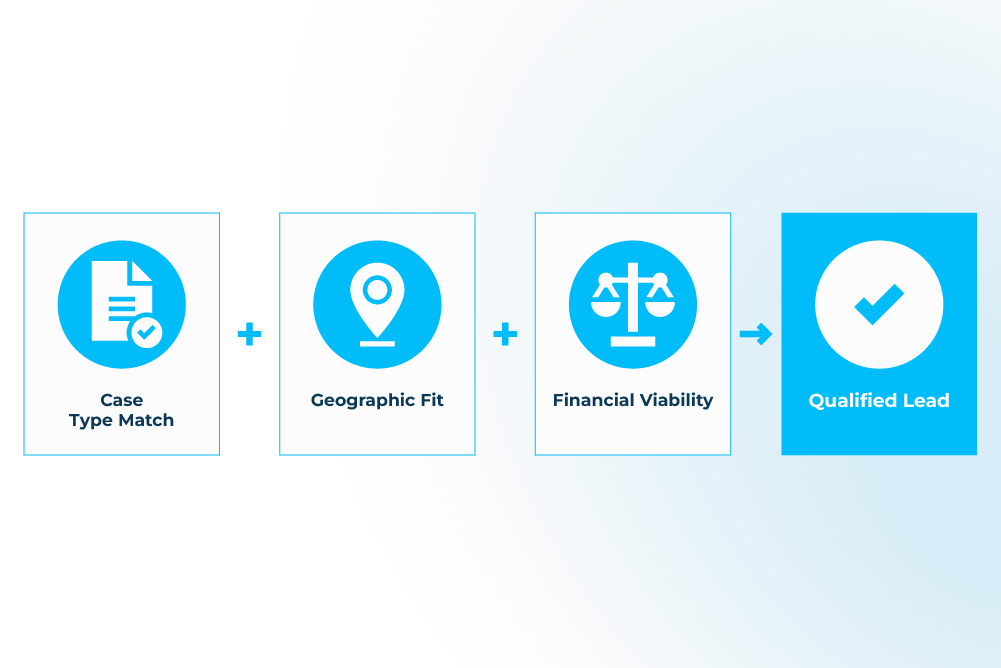
A qualified lead is more than just someone who filled out a form, called, or asked for help after an accident. They fit your firm’s case focus, are in the right location, and have enough financial potential to make it worth your team’s time and effort.
This article breaks down the framework, why it matters for your operations, and how better filtering can protect your team’s capacity and your firm’s profits.
Why Lead Volume Doesn’t Equal Opportunity
It’s easy to count how many leads you have. It’s much harder to know how many of them are actually useful.
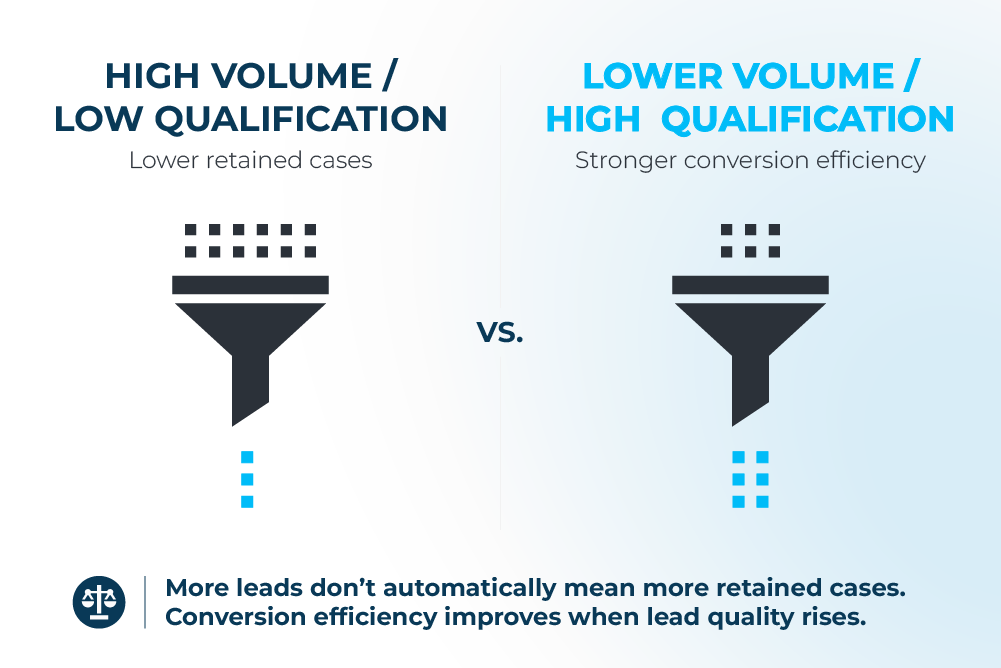
This is where many firms struggle. More leads can make it seem like things are moving forward, but if many are a poor fit, unreachable, outside your area, or not financially strong, the numbers just create confusion and slow you down.
That’s why it’s more important to focus on lead quality than just the total number. A lead that seems cheap at first can quickly become costly if it takes up your staff’s time, an attorney’s attention, and extra follow-up.
Your intake team only has so much capacity. Every minute spent on the wrong leads is time not spent helping the right ones move forward.
This is how revenue starts to slip away — not usually from one big mistake, but from small, repeated issues with response times, screening, prioritizing, and follow-up.
The Cost of Poor Qualification
Poor qualification isn’t just a marketing issue. It’s an operational problem too.
When intake teams get too many low-quality leads, their attention is split. Follow-up slows, good leads wait too long, and staff waste time on cases that were never a good fit. Over time, this leads to lost clients and uneven results.
This is especially costly in personal injury law, where timing is critical. People seeking representation usually need help right away; they may be dealing with medical problems, insurance issues, and a lot of uncertainty. If your team is overwhelmed with unqualified leads, the best potential retainers can get missed.
The issue isn’t just lost time. It’s also about using your team’s capacity in the wrong places.
It can look like:
- Delayed callbacks on strong opportunities
- Inconsistent screening standards across intake staff
- Unnecessary handoffs or duplicate review
- Lower close rates despite steady lead flow
- Poor visibility into what is actually driving retained cases
That’s why firms need a lead-qualification framework before increasing their marketing spend. Without it, growth often leads to more problems instead of better control.
Three Factors That Define a Qualified PI Lead
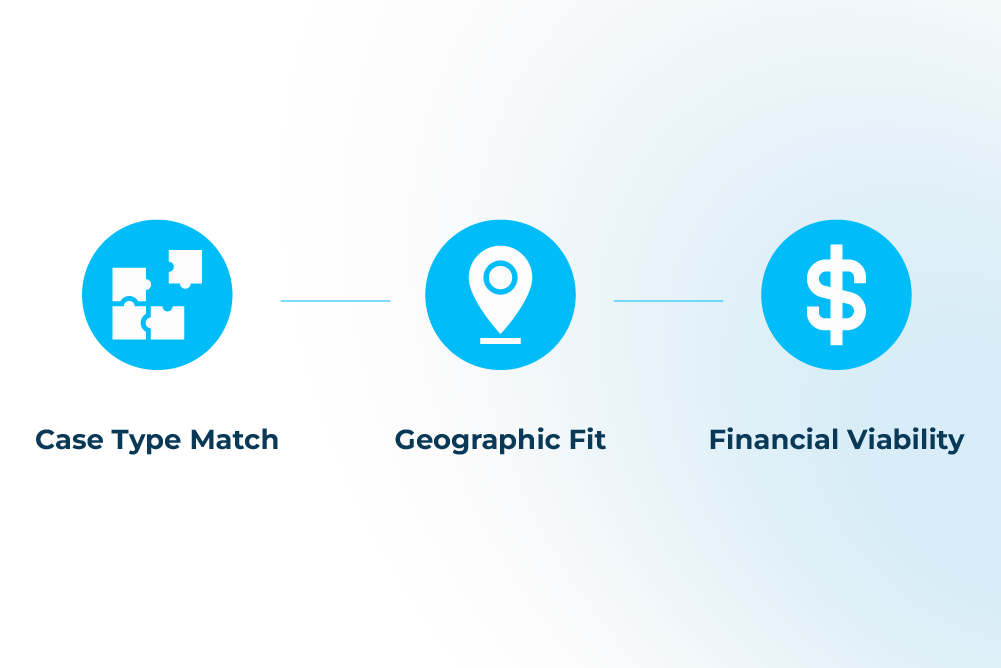
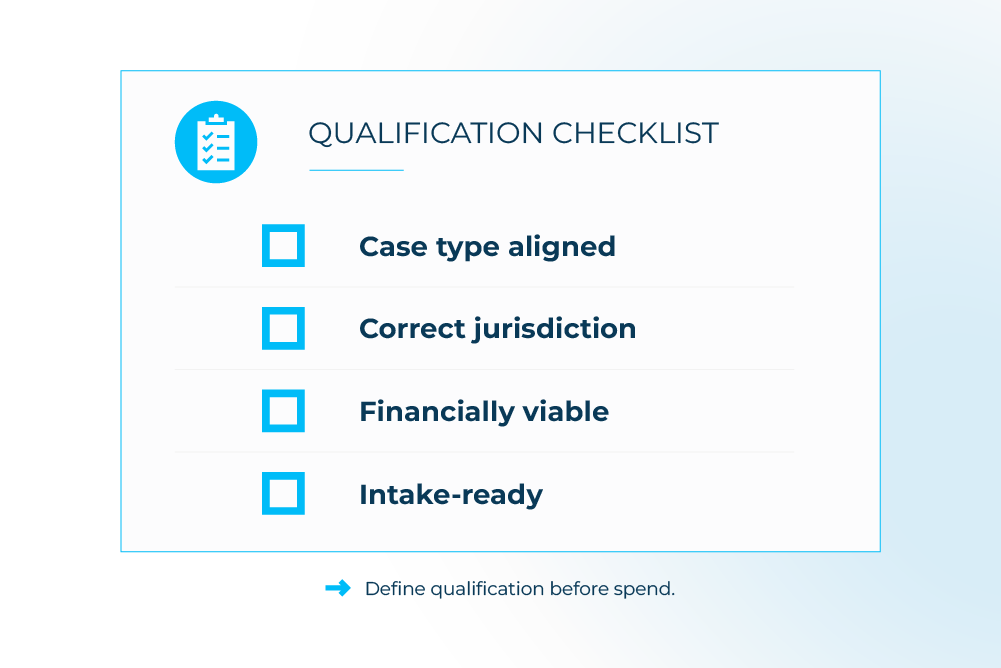
A strong PI lead usually needs to pass three checks before your team spends time on it: case type match, geographic fit, and financial viability.
If any of these are missing, the chances of converting that lead drop quickly.
1. Case Type Match
The first thing to ask is simple: Does this lead match the type of case your firm wants to handle?
This might seem obvious, but in reality, firms often review many leads that don’t fit their case priorities or what they’re set up to handle.
A lead might fall under personal injury law, but still not be a good fit. The problem could be weak liability, low damages, unclear facts, or a mismatch with your firm’s strengths. That’s why personal injury lead generation shouldn’t just be about getting more inquiries. The real goal is to match incoming leads with the cases your firm can handle well.
For firms that focus on certain types of cases, like motor vehicle or commercial accidents, this filter is even more important. Cases that don’t fit your focus might still come in, but they shouldn’t get the same attention as those that do.
2. Geographic Fit
A lead can be valid in theory and still be unusable in practice if it falls outside the right geography.
Personal injury cases depend on state laws, your firm’s coverage, and where you’re licensed to practice. Geographic fit isn’t just about being close by; it’s about whether your firm can actually take the case in that area.
This is a common reason why lead numbers can be misleading. A form filled out from the wrong state still shows up as a lead, but it’s not a real opportunity if your firm can’t take the case.
You should screen for geography early and consistently. If not, your intake team will waste time on cases that should have been filtered out before anyone reviewed them.
3. Financial Viability
A lead might fit your case type and location, but still fail the third check: financial viability.
At this stage, firms need to look beyond just having a lead and ask whether the case is likely to be worth the cost of taking it on. This means considering the expected value, whether there’s insurance or another way to recover money, the claim’s complexity, and how long it might take to resolve.
Legal education resources from the American Bar Association, AllLaw, and the Sacramento County Public Law Library all reinforce the same basic reality: personal injury value is shaped by liability, damages, and recoverability, not just by the fact that an accident occurred.
This focus on the bottom line is crucial for successful intake. A lead isn’t financially viable just because someone needs a lawyer. It’s only viable if the likely outcome justifies the time and money your firm will spend.
Why Qualification Should Happen Before Spend
Too many firms wait until after the fact to judge lead quality. They buy a lot of leads first, then wonder why conversions are low, intake is overwhelmed, or costs are high — even when the number of leads looks good. By then, the waste has already occurred.
You should set your qualification criteria before spending on leads.
This means deciding ahead of time what case types you want, which locations you’ll serve, what financial standards matter, and what should be filtered out right away. It also means making sure marketing and intake teams are on the same page.
If your standards aren’t clear, each team will use its own idea of quality. Marketing will report one thing, intake will see something else, and leadership will get mixed messages. No one will have a clear view of what’s really working.
If you’re looking at lead providers, make sure to ask the right questions before you choose. If qualification standards aren’t clear from the start, it’s hard to have productive conversations about performance later.
How Better Filtering Protects Intake Capacity
Better filtering doesn’t limit your opportunities. It actually protects them.
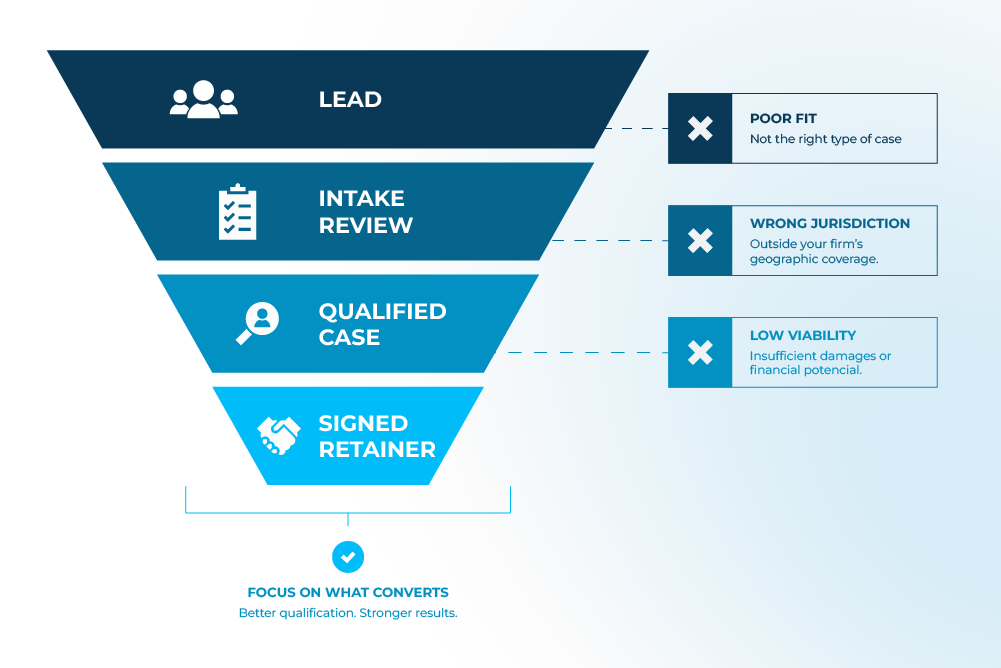
When your team spends less time on poor-fit cases, they can respond faster, follow up more reliably, and move good leads through intake more efficiently. That’s how you improve conversions.
The firms that perform well over time aren’t always the ones buying the most leads. They’re often the ones creating enough structure around intake to ensure strong cases are identified, prioritized, and acted on quickly.
Filtering also improves operational visibility. Instead of asking why a big lead number is underperforming, firms can start measuring what matters more: how many opportunities passed qualification, how many moved through review cleanly, and how many ultimately became retained cases.
What a Structured Qualification System Looks Like
A structured qualification system doesn’t need to be overly complicated. It does need to be consistent.
At a minimum, it should include:
- Clear intake criteria tied to case type, geography, and financial viability
- Shared thresholds for what moves forward and what doesn’t
- Early filtering before unnecessary staff time is spent
- Integration with intake workflows and follow-up systems
- Reporting that shows qualified opportunities, not just raw lead totals
This is how full-funnel intake control becomes more than just a buzzword; it turns into a real, practical way to run your firm.
Quintessa doesn’t just bring in leads. We help manage qualification and follow-up, so your team’s capacity is protected, and your growth is more predictable. This matters because demand without structure usually leads to inefficiency.
Better Leads Start With Better Filters
Not every lead deserves the same attention.
When firms set clear qualification standards before spending, they protect their intake team, cut down on wasted effort, and help strong leads move quickly to signed retainers. Without this, high lead volume often hides inefficiency until the costs show up later.
Better filtering gives you more control. More control leads to better conversion rates. And better conversion is what makes growth steady and predictable.
If you want to see how Quintessa handles full-funnel intake control, learn more about our process or request an intake overview.