

A low cost per lead (CPL) can make your marketing look efficient, that is, right up until you realize it’s not producing enough signed cases.
That’s the trap.
For personal injury firms, CPL is one of the easiest metrics to report and one of the easiest to misread. It can make volume look like progress. It can make weak lead quality look acceptable. And it can hide the real issue: your team is spending time, money, and energy on inquiries that never turn into revenue.
Meanwhile, intake gets stretched. Follow-up slows down. Better opportunities slip. And the number that looked so good in the dashboard starts to matter a lot less.
That’s why CPL is an incomplete metric. It tells you what it costs to generate an inquiry. It doesn’t tell you whether that inquiry was qualified, convertible, or worth the spend in the first place.
The firms that grow more predictably are not the ones chasing the cheapest leads. They’re the ones measuring the actual cost of acquiring a client.
Why Cost Per Lead Looks Better Than It Actually Is
CPL is popular because it’s simple and easy to report. It’s also easy to compare from month to month. It lets marketing teams and firm leaders quickly say, “We’re getting leads at a lower cost.”
But that simplicity can also be misleading.
CPL only measures activity at the very start of the process. It doesn’t measure quality or intent. It doesn’t show if the lead was reachable, qualified, or likely to become a client. It also doesn’t tell you if your intake process could turn that lead into a signed case.
That creates a dangerous dynamic. Firms start optimizing for what is easiest to measure rather than what is most closely tied to profitability.
A lower CPL can make performance look stronger while actual business outcomes stay flat. In some cases, they get worse. More volume enters the system, but the added volume creates drag rather than growth. That’s one reason firms evaluating personal-injury lead generation need to look beyond inquiry counts and focus on what happens after demand is created.
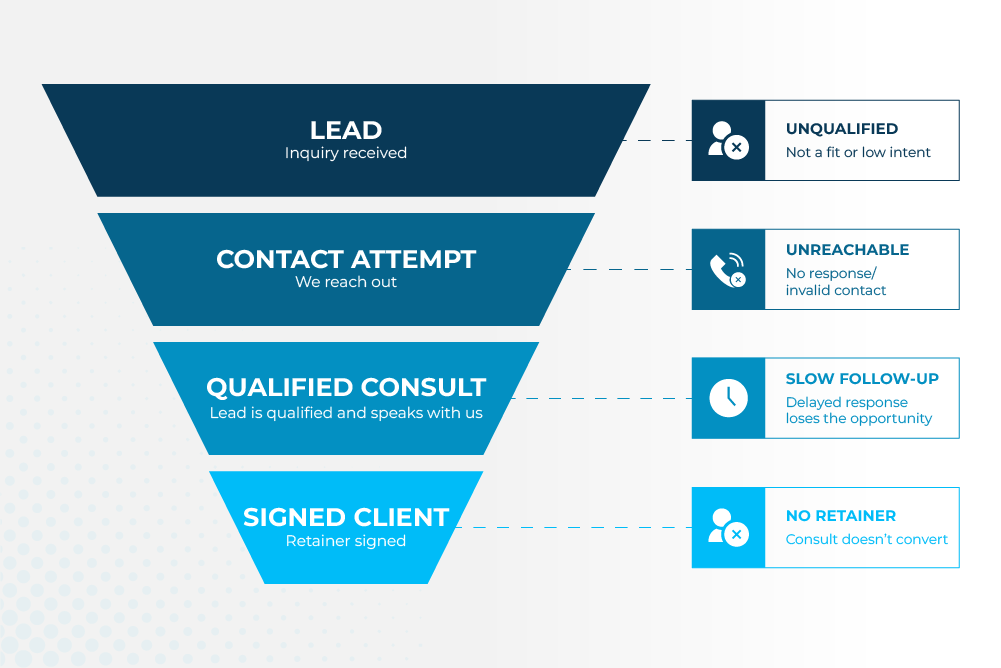
Cheap Leads Can Be the Most Expensive Leads
A cheap lead isn’t really cheap if it wastes time, slows your team, and never turns into a client.
This is where many personal injury firms get stuck. They assume that a lower acquisition cost means better results. When in reality, poor-quality leads often bring hidden costs that don’t show up in the CPL number.
Your intake team still has to answer calls, review cases, follow up, and decide if the lead is a good fit. Your staff spends time on people who may not qualify, may not respond, or were never a fit in the first place. That time costs money.
Even worse, too many poor-quality leads can get in the way of better opportunities. When your team is busy with weak leads, they may respond slower to stronger cases. This doesn’t just waste your budget; it can mean missing out on revenue.
That’s why looking at lead cost alone isn’t enough. True marketing efficiency should include your team’s workload, your ability to follow up, and the number of leads that actually convert. Otherwise, you’re only seeing part of the problem.
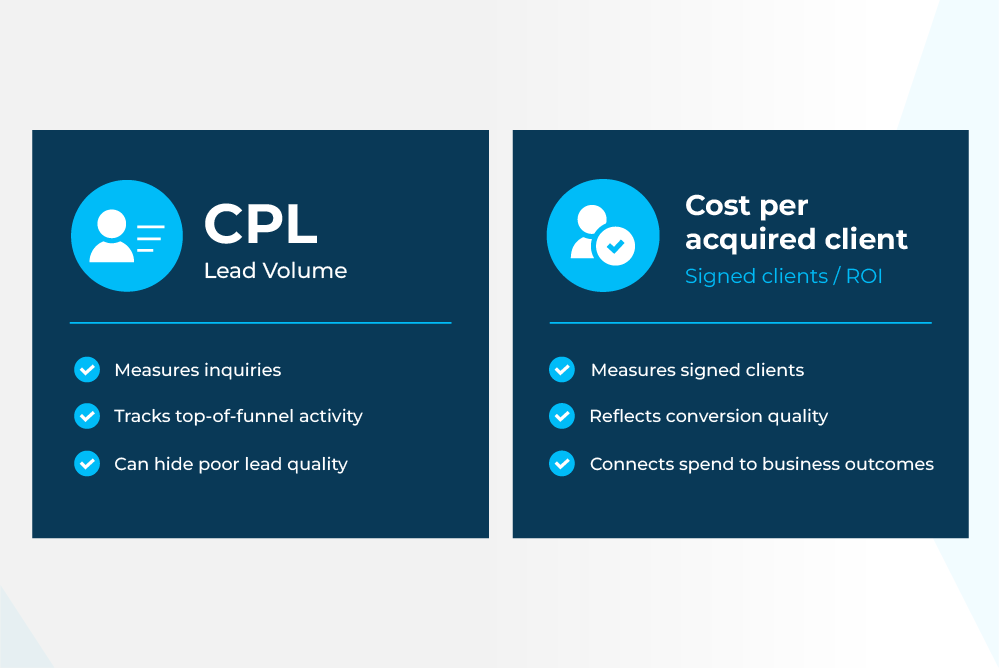
Why Cost Per Acquired Client Tells the Real Story
Cost per acquired client (CPAC) is a more useful metric because it’s tied to business outcomes, not just activity.
Simply put, CPAC shows how much you spend to sign each client. Instead of stopping at the inquiry, it tracks performance all the way to the most important point: proceeding to trial or settlement. This makes it a more strategic metric right away.
It leads to better questions. Instead of just asking, “How many leads did we get?” you start asking, “How many became real opportunities?” Instead of only looking at volume, you ask, “Did that volume turn into signed clients at a good return?”
This is the difference between just looking at surface-level reporting and actually understanding how your operations work.
A firm might pay more for leads from one source but still do better if those leads convert more often. Another source might offer lots of cheap leads, but if few become clients, it’s not as valuable. When you compare both by looking at acquired clients, the better investment is clear.
That’s why firms aiming for steady growth should focus less on the cheapest leads and more on the most efficient way to sign clients. Many firms eventually stop asking if personal injury leads are worth it and start asking if those leads are turning into real business.
Conversion Quality Matters More Than Top-of-Funnel Volume
Not all leads deserve equal value.
That might seem obvious, but many firms still treat every inquiry as if it’s the same. In personal injury, that doesn’t hold up. Lead quality, intent, case fit, and the chances of response or retention all vary.
Better leads reduce wasted effort throughout the process. They make intake smoother, improve response results, and give your team a better shot at turning work into revenue.
Poor-quality leads do the opposite. They take up time, inflate activity numbers, and create noise that makes things look productive when they’re actually not.
This is where firms often mix up activity with real performance. More calls, forms, and inquiries can make it seem like things are moving forward. But if those contacts aren’t turning into qualified clients, the extra volume isn’t fixing the real business issue. It might even make the real problem harder to spot.
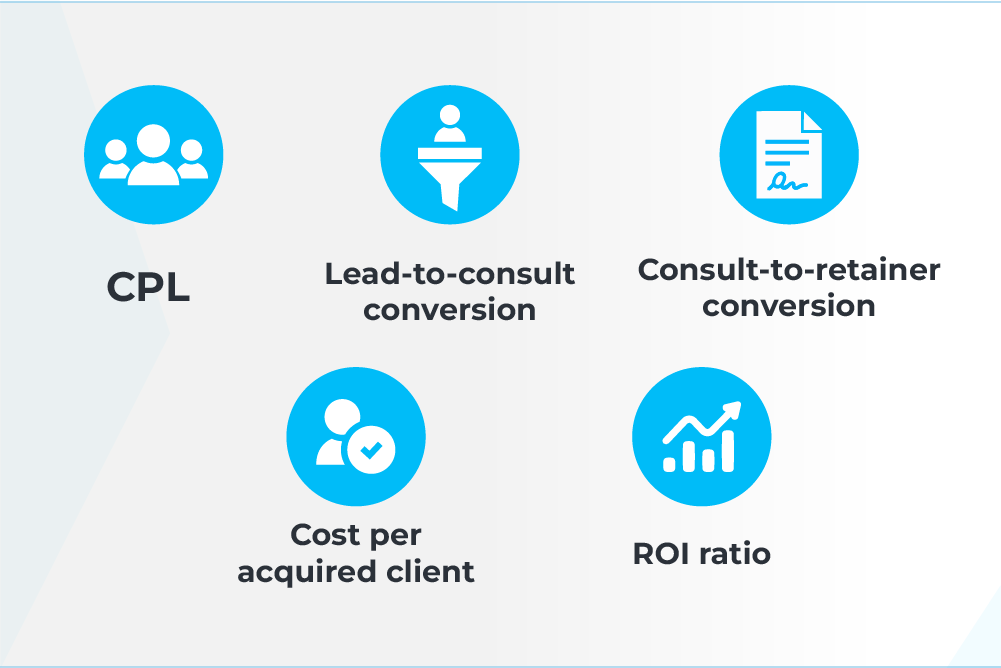
The Metrics PI Firms Should Look At Together
No single metric tells the full story. But CPL, by itself, tells the least.
You get a better sense of performance by looking at a group of KPIs that show both marketing efficiency and how your operations really work. These include:
- Cost per acquired client
- Lead-to-consult conversion rate
- Consult-to-retainer conversion rate
- Signed client volume
- ROI ratio
- Speed to contact and follow-up performance
Together, these metrics show whether your inbound demand is actually producing business value.
For example, speed to contact helps explain whether strong leads are being engaged fast enough. Lead-to-consult conversion shows whether the inquiry was viable in the first place. The consult-to-retainer rate reveals whether the opportunity was qualified and handled effectively. Cost per acquired client ties all of it back to spend.
That’s a much more useful way to evaluate performance than a single top-of-funnel number. It also aligns more closely with how firms should think about marketing ROI for law firms, which depends on outcomes and return rather than lead volume alone.
What Better Performance Measurement Actually Supports
When you track the right metrics, you can make better decisions.
You can allocate budget more confidently because you know which sources are producing retained clients, not just inquiries. You can improve operational visibility by evaluating marketing and intake against shared outcomes. You can spot where revenue leaks are happening instead of assuming the problem starts and ends with traffic or lead flow.
Most importantly, you create better alignment between demand generation and intake execution.
That matters because growth in PI isn’t just about bringing in more leads. It’s about controlling what happens next. Without visibility across intake workflows and follow-up systems, firms lose cases in small but compounding ways. High volume often masks inefficiency. Stronger measurement helps expose it.
This is also where Quintessa’s model becomes different from a volume-only approach. We aren’t focused on generating activity for its own sake. We manage inbound demand through full-funnel intake control, qualification, and follow-up systems designed to support better conversion outcomes — not just more names in the pipeline. If you want a clearer picture of how that works operationally, it helps to understand how Quintessa’s broader services support firms beyond top-of-funnel volume alone.
For firms focused specifically on auto cases, that becomes even more relevant in high-volume practice areas like motor vehicle accidents, where speed, qualification, and follow-up discipline can make a major difference in acquisition efficiency.
A Better KPI for Firms That Care About Profitability
A cheap lead isn’t a win if it never becomes a client.
That’s the simplest way to think about this issue, and it’s the one many firms miss when CPL becomes the headline number. Low cost at the top of the funnel doesn’t automatically mean efficient growth. In many cases, it hides weak conversion, operational waste, and missed opportunities.
Firms serious about profitability also need to keep a close eye on the broader market and on how legal consumers engage, as shown in resources such as the Legal Trends Report. And because lead sourcing in legal requires care and credibility, performance conversations should stay grounded in compliant, transparent practices consistent with the ABA’s guidance on lawyer advertising and lead generation.
If your goal is predictable growth, you need a set of metrics that reflect what your business actually depends on: qualified retainers, operational visibility, and return.
That starts by moving past vanity metrics and asking a better question.
Not “How cheap was the lead?” But “What did it cost us to acquire a client — and was it worth it?”
Request an intake overview and get started with Quintessa Marketing today. We’re ready to help you grow your firm.