
When signed cases aren’t coming in as they should, most personal injury firm owners start looking for answers in the same places: the marketing budget, lead vendors, and cost per lead. The instinct is usually to blame the lead flow first. Get more leads, solve the problem, right? A seemingly logical frame through which to view the issue.
What that frame leaves out is all the client acquisition near-misses that happen after the lead arrives.
This is the intake efficiency gap, and it costs personal injury firms more in lost revenue than most owners realize. Not because they aren’t generating enough demand, but because their intake infrastructure isn’t built to protect the value of the leads they already have.
The solution? A marketing partner that saves you time and money by providing real value in the form of screened, vetted, and signed retainers. Because you didn’t go to law school to create intake forms.
The Anatomy of a Broken Intake Process
Let’s break down the process. For example, a prospect gets injured in a multi-car accident on Thursday afternoon. They call two firms that evening. Firm A sends them to voicemail. Firm B answers immediately, but never follows up after the initial conversation. By Friday morning, that prospect has signed with Firm C.
Nobody inside Firm A or Firm B thinks they “lost” a case. And technically, they’re right. The lead was never qualified. But the opportunity was real all the same. What Quintessa has noticed is that while most PI firms say they have an intake process, many actually have a collection of individual habits held together by good intentions.
Why does that distinction matter? Because a broken intake process doesn’t always look broken. The phone gets answered. Leads get logged. Cases get opened. All that activity is easy to mistake for performance. But underneath that surface-level activity, qualified opportunities are slipping away — one inefficiency at a time.
Intake inefficiency rarely shows up as a single catastrophic failure. If it did, it would be easy to track. Unfortunately, the gap shows up in smaller, less visible ways:
- Calls get answered inconsistently
- Voicemails sit too long before anyone follows up
- Web form submissions and chat inquiries wait hours or days
- Different intake staff ask different questions
- Qualification criteria exist in someone’s head, but aren’t standardized across the team
The result is a firm that looks operationally fine on the surface, but is quietly hemorrhaging opportunity underneath. On paper, the intake operation looks busy. In practice, good cases are leaking out of it every day.
Understanding why starts with understanding what good intake actually costs, and what broken intake actually loses.
The True Cost of Missed and Mishandled Inquiries
Every personal injury firm has a set of intake costs it can see clearly: paid media spend, lead vendor fees, intake staffing, etc. These show up on invoices and in budget reports. They’re easy to point to.
What’s much harder to see are the hidden costs of intake inefficiency.
When a qualified lead doesn’t convert, the firm doesn’t just lose the revenue from that case. It loses the entire marketing investment that generated the lead in the first place. Every dollar spent acquiring that prospect through paid search, social ads, or lead vendor fees is now sunk cost. The lead wasn’t necessarily bad. The firm just couldn’t convert it.
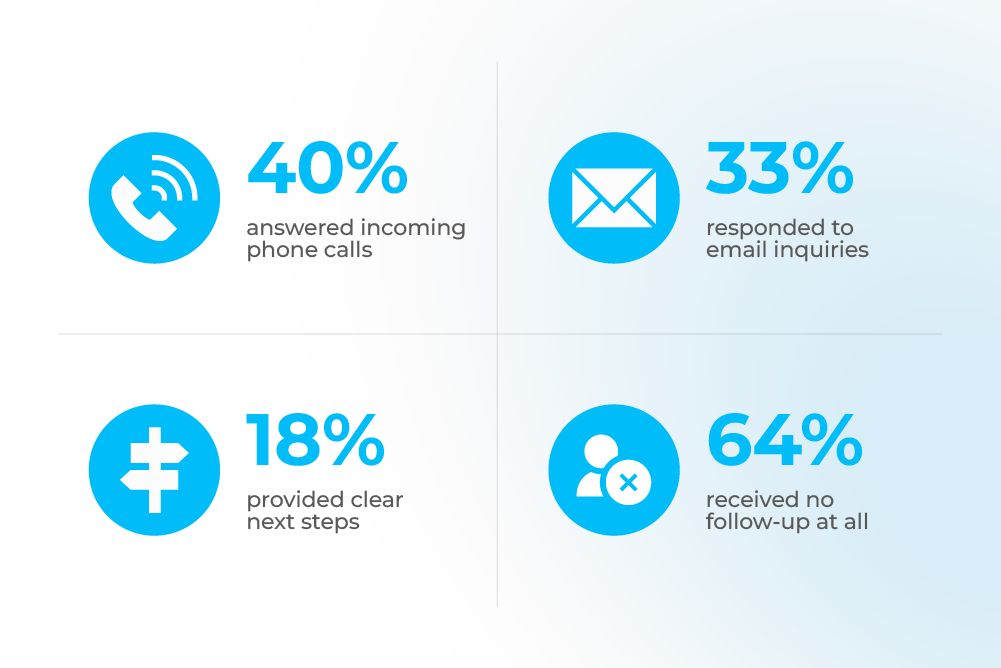
And the data make it clear that this problem is widespread. According to Clio’s 2024 Legal Trends Report, which used a third-party firm to conduct a secret shopper study of 500 law firms, only 40% of firms answered incoming phone calls from prospective clients, down sharply from 56% in 2019. Email responsiveness was even more troubling. Just 33% of firms responded to email inquiries, down from 40% five years earlier. In total, nearly half of all firms were essentially unreachable. When firms did respond, only 18% provided clear next steps, a drop from 30% in the previous study, and across phone and email, a shocking 64% of prospective clients received no follow-up at all.
The PI-specific numbers make this even clearer. According to MyCase’s 2024 Benchmark Report, personal injury firms generated more than 36,000 leads in 2023, but converted just 7% of those leads to consultation appointments.
None of this can be fixed by simply dumping money into marketing. These are intake problems, and they cost firms cases they never even knew they had a chance to win.
Beyond the wasted acquisition cost, broken intake creates drag throughout the organization. Staff time gets burned chasing leads that should have been disqualified before they ever hit the queue. Attorneys spend time reviewing weak inquiries that never had a path to retainer. Duplicate follow-up work piles up because no one logged the first contact properly. Inaccurate CRM data makes reporting unreliable. Intake teams dealing with constant disorganization and overload experience lower morale, which degrades the quality of every interaction that follows.
A lead doesn’t have to be unqualified to be wasted. It can be delayed, mishandled, or just lost in the shuffle somewhere between intake and attorney review. And that means real revenue that was within reach but slipped through your fingers, not because the marketing failed, but because the intake system couldn’t protect your marketing investment.
Intake Load vs. Intake Capacity
There’s a difference between how many leads are coming in and how many leads a team can actually handle well. PI firms often focus heavily on the former without asking enough hard questions about the latter.
Intake load is the total volume and complexity of inbound inquiries the team needs to process. It includes:
- Call volume
- Web form submissions
- Chat inquiries
- Text messages
- After-hours leads
- Duplicate contacts
All of these are shaped not just by raw numbers but by the nature of the leads themselves — complex cases with multiple parties, leads requiring additional documentation, or even injured parties who need more time and empathy to feel comfortable moving forward.
Intake capacity is the team’s actual ability to process that load at speed, with quality and consistency. That includes stagg count, training depth, workflow structure, CRM functionality, and after-hours coverage, to name a few.
When the load exceeds capacity, intake teams stop operating proactively and start operating reactively. Staff gravitate toward whichever call feels most urgent in the moment, while earlier inquiries quietly drift further down the queue. Follow-up gets inconsistent. Notes get shorter. Conversations become more transactional because nobody has enough time to slow down and really listen to the person on the other end of the phone.
That’s what makes this problem so easy to unintentionally exacerbate. More lead volume doesn’t automatically create more signed retainers if the intake team is already overloaded. It usually just creates more pressure. More callbacks happen too late. More qualified prospects who never hear back quickly enough. More people reaching out after an accident and walking away with the feeling that nobody at the firm really had time for them.
Firms that scale well understand that lead generation and intake capacity have to grow together. They don’t treat intake like an administrative afterthought that gets addressed later. They treat it as part of the conversion strategy itself, because even strong marketing can’t compensate for an intake operation that’s already underwater.
Why Speed Alone Doesn’t Fix Broken Intake
Response times are crucial. A prospect who contacts your firm and hears back in five minutes is far more likely to stay in the conversation than one who waits two hours. That urgency is real: research consistently shows that the majority of potential clients choose the first firm that responds to their inquiry. According to Stafi’s analysis of legal intake data, 67% of legal clients choose the first attorney who answers their call. And in a market where injured prospects are contacting multiple firms simultaneously, the firm that picks up second often gets nothing.
But speed is not a system. It’s a component of a system.
Sure, a fast response gets the conversation started. What happens inside that conversation determines whether it becomes a qualified opportunity. And there are plenty of ways a fast response can still fail. Intake staff who answer quickly but don’t ask the right questions can miss case details that affect qualification. Prospects who feel rushed or talked at rather than heard don’t want to commit. Important notes might not get captured because the conversation moved too fast.
The Clio secret shopper study in the Legal Trends Report underscores just how much a live human conversation matters. Prospective clients who managed to speak with someone over the phone were more than three times more likely to recommend the firm than the average across all contact channels, and nearly eight times more likely to recommend than those who only received a voicemail callback. Speed gets you to the phone, but the quality of that conversation is what converts.
Speed is necessary, but structure with room for human contact is what makes the speed pay off.
Strong intake systems pair rapid response times with a defined conversation framework: what to ask, in what order, how to listen, how to document, and how to guide the prospect toward the next step with empathy. Without the time to build a connection, prospects slip away, and your intake team has less time to build that connection if they’re overextended.
How Administrative Overload Compounds Conversion Loss
Ask most intake professionals what they actually spend their time on, and you’ll quickly discover that answering calls is only part of the job. Intake teams are routinely responsible for CRM data entry, status updates, missing information follow-up, lead routing, document requests, and internal communication, all while managing a live queue of inbound inquiries.
When administrative load gets heavy, conversion suffers in ways that are hard to trace directly back to the source.
The intake professional who spends 40 minutes cleaning up CRM entries from yesterday is 40 minutes less available to follow up on the qualified lead that came in this morning. The team managing a high volume of cold or low-quality leads that require repeated contact and documentation before disqualification has less time and attention for the prospects with real conversion potential. The staff member buried in paperwork isn’t bringing their best presence to the next call.
This draws a direct line between vetted leads and conversion. Firms working with a high volume of poorly matched leads spend more time chasing, documenting disqualifications, and sorting through CRM noise. All of which costs in staff capacity, team energy, and the attention available for leads that actually matter.
How Lead Quality Changes Intake Economics
The point that gets lost when firms evaluate their options purely on cost per lead is that not all leads create the same workload.
Low-quality leads create more problems than most firms realize. Even when a prospect is obviously outside the firm’s target criteria — wrong geography, wrong case type, little chance of converting — the intake team still has to spend time working the lead. Someone has to make the call, ask the questions, document the interaction, update the CRM, and eventually close it out. Multiply that across dozens or hundreds of weak inquiries, and the effect adds up fast. Pipelines get cluttered, reporting gets noisier, and intake staff end up spending valuable time on prospects that were never likely to sign in the first place.
Higher-quality leads change that equation. Well-vetted prospects with strong case indicators and a clear fit for the firm tend to move through intake faster and with less friction. Conversations become more productive. Qualification happens faster. Follow-up is more focused. And perhaps most importantly, intake teams can spend their time where it actually matters instead of constantly sorting through noise. Better leads may cost more upfront, but they often create a more efficient intake operation from start to finish, which makes the person on the other end of the phone feel heard.
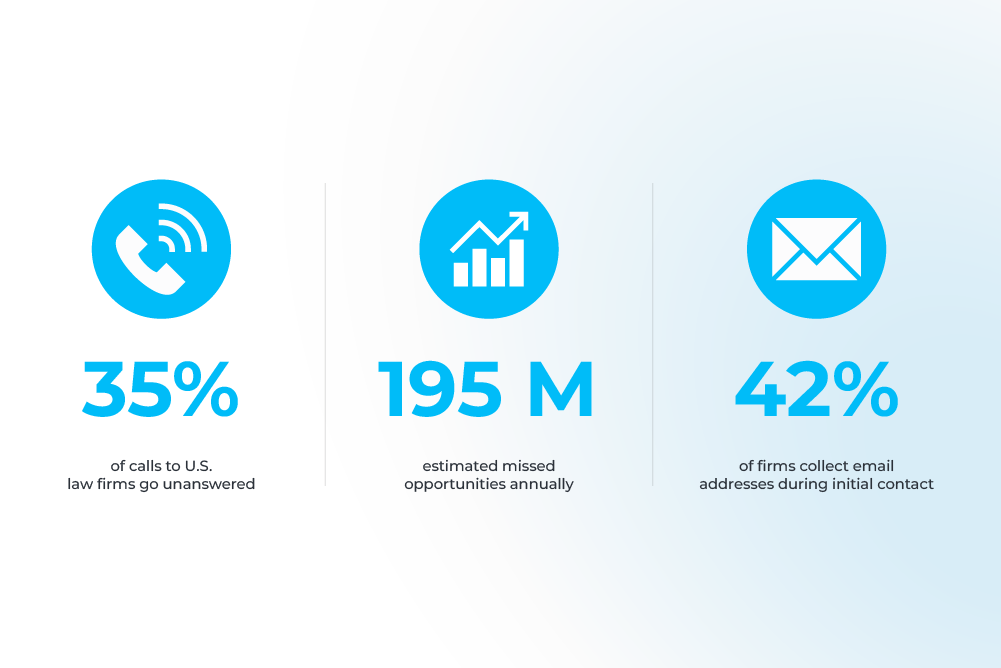
The data backs this up. According to Setmore’s research on law firm call handling, 35% of all calls to U.S. law firms go unanswered — representing an estimated 195 million missed opportunities annually nationwide. When firms also consider that, according to MyCase’s benchmark data, only 42% of firms even collect email addresses from prospective clients during initial contact, the picture gets bleaker: a missed call with no email on file is a permanent dead end.
Cheap leads aren’t cheap once your staff has spent hours chasing them. That nominal cost per lead that looked favorable is anything but once you account for staff hours, CRM noise, and the slipping conversion numbers from a high volume of inquiries that just don’t suit your business model.
Lead quality and intake quality must work together. You can have excellent intake infrastructure and still struggle if the leads flowing into it are consistently low quality. You can have genuinely strong leads and still lose them if intake can’t convert them. Neither one fully compensates for the other, which is why PI firms that are serious about growth invest in both. Qualified leads are worth the investment when the intake system is ready to receive them.
Why Firms Misdiagnose Intake Problems as Marketing Failures
A lead can fail for many reasons unrelated to the marketing channel that generated it. Maybe the response came too late, or the prospect was never contacted at all. Maybe the notes were too incomplete to move the case forward. Maybe, through no fault of the intake team, the case type was wrong for the firm. In a crunch, maybe the prospect signed with another firm first because they felt like they were getting more attention there.
If none of those points of failure get tracked, your firm has no way to diagnose the actual failure. As research from Above the Law’s coverage of MyCase benchmarking data makes clear, tracking lead performance by stage — not just by closed/lost outcome — is the only way firms can identify where conversion is actually breaking down and make intelligent decisions about where their marketing investment is working.
When firms can’t clearly see where leads are falling out of the process, they start making decisions based on incomplete information. Good lead sources get blamed for problems that actually happened during intake. Weak sources keep getting budget because the volume looks healthy on paper, even if a few of those leads sign. And in many cases, firms respond to disappointing conversion numbers by buying more leads, when the real issue is an overloaded or inconsistent intake process.
That’s why cost per lead only tells part of the story. The numbers that really matter are things like signed cases by source, cost per acquired client, and return on investment at the retainer level. But firms can only measure those accurately if the intake data behind them is clean and consistent. Otherwise, they’re making growth decisions without a clear picture of what’s actually working. Before a firm can improve lead conversion, it has to understand what happens after an inquiry comes in.
Designing Intake for Predictable Conversion
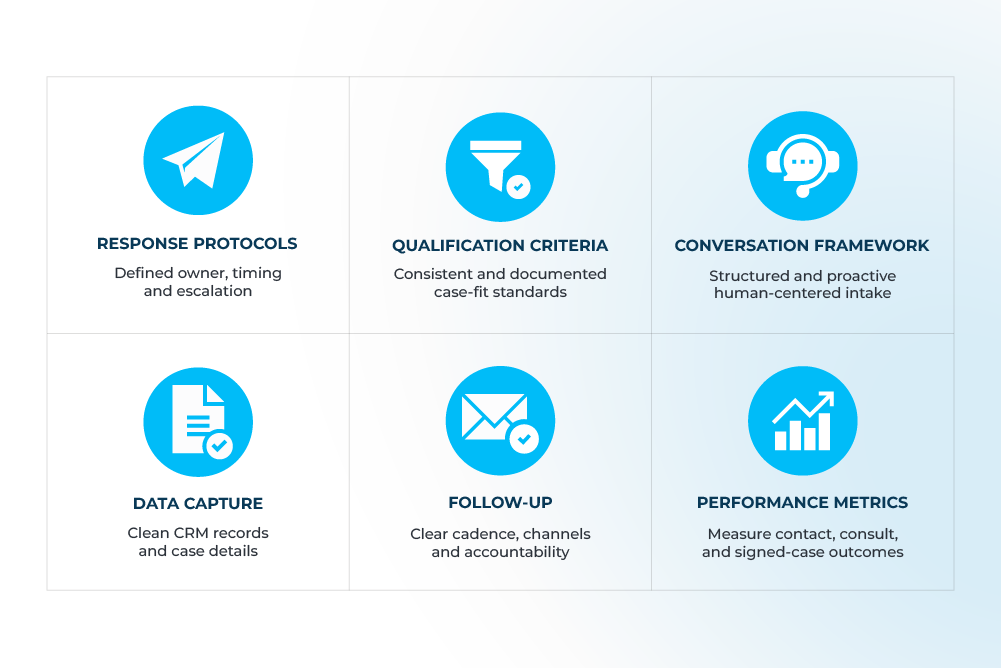
What distinguishes firms that scale from firms that stall is designing intake as a conversion system with clear standards, defined workflows, accountable ownership, and measurable outcomes. That doesn’t mean intake becomes robotic. It means intake becomes reliable. Here’s what that looks like in practice.
Clear Response Protocols
Every inquiry type needs a defined owner and a defined response expectation. Who answers calls during business hours? Who handles after-hours and weekend leads? What happens when a call goes to voicemail? Who calls back, when, and how many times? How are web form submissions handled, and what’s the maximum acceptable response window?
The answer to each of those questions should be written down, trained on, and enforced consistently. A firm where the answer is “it depends on who’s available” has a protocol gap, not a staffing solution. And this becomes painfully obvious after hours. Given that 67% of legal clients choose the first attorney who answers their call, a lead that comes in on a Friday evening and isn’t contacted until Monday morning has likely already moved on.
Consistent Qualification Criteria
Intake staff should not be improvising qualification decisions based on gut feel. The criteria that define a qualified lead should be documented and standardized across the team, including case type, geographic eligibility, and injury severity. Every one of your intake professionals should be working from the same definition of what constitutes a case worth pursuing.
This consistency ensures the right leads get advanced appropriately, and the wrong leads don’t eat up time and money.
Structured Intake Scripts Without Robotic Conversations
Scripts get a bad reputation, but the alternative can be chaotic. The goal isn’t a script that makes staff sound like they’re reading from a form. Instead, it’s a framework that ensures every intake professional knows what to ask, why it matters, and how to build trust with someone who’s having one of the worst days of their life.
Done right, a structured intake script makes conversations feel more natural because staff aren’t stopping to figure out what comes next. They already know.
CRM Discipline and Data Capture
Tracking prospective clients by stage and integrating practice management software into the intake process are crucial to a high-performing intake operation. Every intake interaction should generate a record that includes:
- Lead source
- Case type
- Key case details
- Qualification determination
- Disposition
- Follow-up notes
- Disqualification reason, if applicable
- Handoff details
This is the raw material that provides real visibility. Firms with clean, consistent intake data can identify where leads are dropping off, which sources are performing, and where staff training needs to improve. Firms without it are operating on intuition, not fact.
Follow-Up Cadence and Ownership
One of the most common places qualified leads disappear is in the gap between first contact and follow-up. The prospect wasn’t reached on the first call. Or they were reached, but the next step wasn’t clearly defined. Or the follow-up was supposed to happen, but got lost in a busy afternoon.
Strong intake systems define when follow-up happens after each stage of contact, who owns each follow-up action, which channels are used (calls, texts, emails), what the escalation path looks like when a prospect isn’t responding, and when a lead is re-engaged, recycled, or officially closed.
Intake Performance Metrics
As the saying goes, “What gets measured gets managed.” There’s a laundry list of metrics that matter in a high-performing intake operation: speed to first response, contact rate, qualified consult rate, consult-to-retainer rate, missed call rate, etc. But the ultimate metric is lead-source quality by signed-case outcome. Tracking performance at the signed case level is what allows firms to make genuinely informed decisions about where their acquisition investment is going and whether it’s working.
The Path Forward: Intake as a Strategic Asset
As the research makes plain, the intake efficiency gap isn’t a staffing problem, a technology problem, or a marketing problem. It’s a systems problem, which firms can solve when they’re willing to view intake as a strategic function rather than an administrative one.
At its core, the relationship is simple: marketing creates opportunity, but intake is what determines whether that opportunity ever turns into revenue. When intake systems start to break down, firms lose more than just individual cases. They lose the value of the marketing dollars that brought those prospects in to begin with. And because the problem often looks like a lead-generation issue from the outside, firms can end up spending even more money trying to solve the wrong problem while qualified prospects quietly sign somewhere else.
Firms that invest in stronger intake operations usually see the difference quickly. Better responsiveness. Better follow-up. Better visibility into what’s actually converting. Technology absolutely helps, but software by itself doesn’t fix a broken process. The firms that consistently improve conversion are the ones that combine the right tools with clear workflows, consistent standards, and real accountability for how leads are handled from first contact through to signed retainer.
When those elements are in place, intake becomes what it should be: not a cost center, not a call-answering function, but a revenue-critical system that protects and multiplies the value of every lead the firm acquires. It’s better data, less waste, stronger follow-up, higher confidence in conversions, and more predictable signed cases.
The distance between where most firms are today and where they could be is almost entirely a function of how seriously they take intake as a strategic discipline.
If your firm is generating demand but struggling to turn that demand into predictable signed cases, it may be time to look beyond lead volume. Quintessa helps personal injury firms stop losing qualified prospects inside broken intake workflows. If you’re looking to improve your intake’s efficiency gap, let’s connect.