

Personal injury firms trust their CRM to answer a simple but vital question: what’s working? They rely on a CRM to check lead volume, cost per lead, contact rates, and conversion numbers so they can make the right choices for their business. Where to spend next quarter’s budget. Whether to hire another intake specialist. Which lead vendors to keep or cut.
The problem? Those reports are only as reliable as the data used to build them. And when intake systems are dealing with unqualified, incomplete, or poorly documented leads, the dashboard can’t provide an accurate snapshot.
Bad leads don’t just lower conversion rates. They make the data firms use to make growth decisions unreliable. Without clean intake capture, clear qualification standards, and full-funnel reporting, PI firms can’t see the full picture.
Bad Lead Data = False Signals
Lead volume is easy to measure. Lead quality is not, at least not without disciplined tracking.
For example, a source generates 200 leads per month at $75 per lead. But only 4% of those leads ever reach a consultation, and fewer than half of those sign. That keeps the true cost per acquired client from being reflected in the dashboard. Bottom line: a source can be active without being efficient.
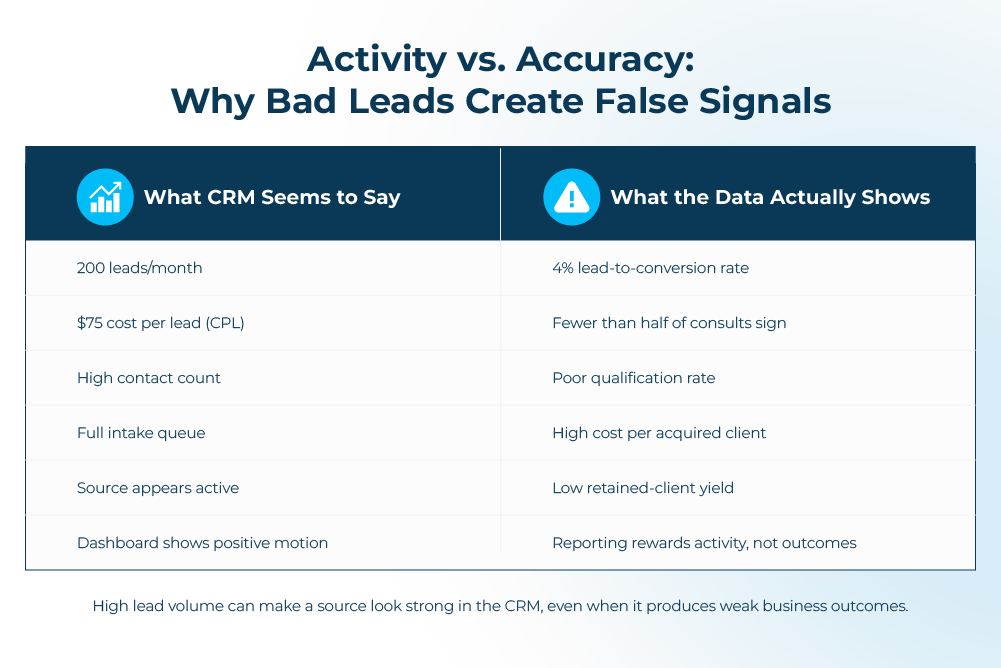
This is how bad inputs create false positives:
- High contact volume gets logged as pipeline activity
- Disqualified leads go undocumented or get filed inconsistently
- Conversion metrics get calculated off the wrong denominator
- Reporting continues to label the source a top performer because it’s generating motion, not clients
Reporting Gets Noisy When Intake Is Overloaded
Unqualified leads don’t disappear when intake receives them. They create work. Each one requires contact attempts, a needs assessment, some form of case evaluation, documentation, follow-up, and eventual disqualification. That process takes time and leaves a trail of incomplete data.
And when even the best-trained intake teams are processing high volumes of low-quality prospects, shortcuts are inevitable. Notes get skimped. Disqualification reasons go unrecorded. Contact fields are left blank. Duplicate records accumulate. The CRM that’s meant to provide clarity starts to fill with partial entries that muddy the waters.
Clio’s research puts some numbers to this problem. Law firms fail to collect an email address 86% of the time during initial contact. They miss phone numbers 45% of the time. And 35% of calls from prospective clients go completely unanswered. Each of these data failures is a broken link in the attribution chain.
The result: qualified leads can get buried in the same clutter as unqualified ones. Not because intake teams aren’t doing their best, but because they’re having to work leads that lead nowhere.
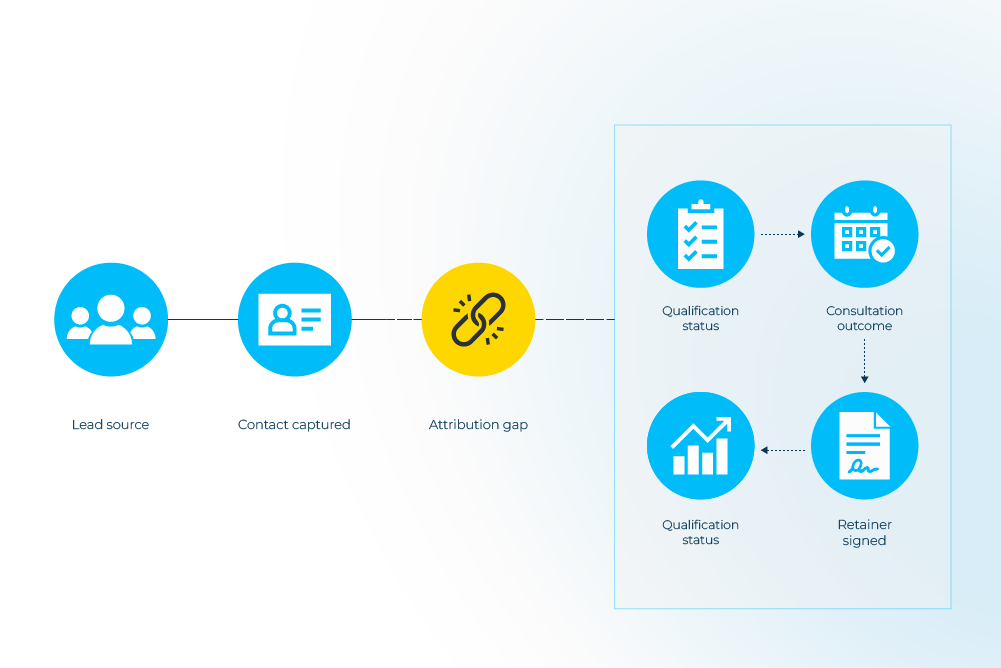
Incomplete Intake Data Breaks the Chain
For a law firm to make smart acquisition decisions, it needs to know which sources produce not just inquiries, but retained clients. That means weaving a continuous thread from first contact to signed retainer: lead source, contact capture, qualification status, consultation outcome, and final conversion.
When any link in that chain is missing, attribution breaks. A firm may know it spent $15,000 across three lead sources in a given month, but have no reliable way to determine which one drove its best clients. Even the smartest firm can’t measure what it can’t trace.
This has implications far beyond the marketing budget. Incomplete attribution also distorts intake performance reviews. If a particular workflow or team member appears to have low conversion rates, it may be because they’re handling a disproportionate number of unqualified leads, not because their process is weak.
Strong personal injury lead tracking requires solid documentation: where the lead came from, when contact was made, what case type was reported, whether geographic and injury criteria were met, what happened at consultation, and whether a retainer was signed. Without that full picture, attribution is expensive guesswork.
Bad CRM Data Leads to Bad Decisions
Unfortunately, polluted reporting doesn’t stay inside the CRM. It influences decisions across the firm.
Budget
Budget allocation can get distorted when low-quality volume sources look productive at the cost-per-lead level. Firms might reinvest in channels that generate noise and pull back from channels that generate fewer leads but better clients. Vendor evaluations can go wrong for the same reason. A firm might cut loose a vendor with lower volume and higher qualification because the data isn’t telling the full story.
Staffing
Staffing decisions can also be affected. When conversion rates are low and intake teams appear overwhelmed, the obvious response is to hire more people. But if the problem is lead quality, not headcount, adding staff doesn’t fix anything. It just means paying more people to process the same low-value pipeline.
Growth Planning
Growth planning can suffer as well. Firms trying to model revenue, forecast retainer volume, or prepare for expansion need numbers they can trust. When the CRM is contending with half-documented leads and unclear qualification outcomes, those projections can’t be fully accurate.
Firms Can’t Optimize What They Don’t Capture
Fortunately, there’s a solution: cleaner reporting. And that starts with consistent data capture.
A well-structured intake record should include: lead source, inquiry date and time, contact method, contact information collected, case type, geographic fit, injury status, liability indicators, qualification status, and, if disqualified, the reason for disqualification. From there, firms can build a more complete picture based on consultation and retainer outcome.
With that data in place, firms can calculate the true law firm lead quality:
- Lead-to-consultation rate: the percentage of leads that advance to a scheduled consultation
- Consultation-to-retainer rate: how often consultations result in signed clients (a benchmark for well-qualified leads is 80% or higher)
- Source-level conversion rate: which specific channels produce retained clients, not just inquiries
- Cost per acquired client: total lead spend divided by clients signed, which paints a far more accurate picture than cost per lead alone
- ROI ratio: average case fee relative to acquisition cost
As a bonus, these metrics do more than create visibility. They also create accountability for lead sources, for intake workflows, and for vendors. PI firms that track this data can make decisions grounded in actual performance.
Cleaner Lead Quality Creates Cleaner Reporting
Clean data isn’t only a process problem. The quality of leads entering the system shapes how much of this is fixable at the intake level. When leads arrive pre-qualified — verified for case type, geographic fit, injury severity, and insurance coverage — intake teams have less to sort through, less to document under pressure, and a cleaner basis for recording outcomes. Records are more complete because each interaction has a defined scope. Disqualification rates drop. Attribution chains remain intact because fewer leads fall through the cracks without documentation.
This is why lead qualification and law firm CRM reporting are connected concerns, not separate ones. Quintessa’s approach to motor vehicle accident lead generation, which combines technology with trained human vetting, is designed to deliver retainers that are intake-ready and reportable, not just contactable. The same applies to commercial accident cases, where complexity makes upfront qualification even more critical.
Fewer incomplete records, less CRM clutter, and clearer source-level reporting all lead to more accurate decision-making.
Reporting Integrity Starts Before the Dashboard
A CRM dashboard reflects what went into it. Unreliable inputs produce unreliable outputs — like the saying goes, “Garbage in, garbage out.” And decisions made from those outputs carry the same uncertainty downstream.
The path to better reporting runs directly through better intake. Consistent data capture, clear qualification criteria, and lead sources that deliver prospects worth documenting in the first place.
For PI firms ready to move past noisy lead volume, the real question isn’t just how to improve conversion; it’s how to build a pipeline where the numbers tell the real story. Quintessa helps firms get there, from inbound demand to qualified retainers, your intake team can act on with confidence. Let’s talk.