
Imagine two personal injury firms are comparing lead sources. One can get inquiries for $100 apiece. The other is paying $300 a pop. You can almost hear the first firm congratulating itself on the deal, can’t you? Why spend three times as much for something you can get cheaper?
Because the price tag isn’t the whole picture.
If those $100 leads rarely turn into signed retainers, the apparent bargain can become a very expensive way to keep the intake team busy. The question for PI firms is whether they’re paying less to generate interest or paying less to acquire actual clients.
What Does Cost Per Lead Really Tell You?
Cost per lead (CPL) measures how much a firm spends, on average, to generate an inquiry. The calculation is straightforward:
CPL = Lead Generation Spend ÷ Number of Leads Generated
Spend $10,000 on a campaign that produces 100 leads, and your CPL is $100.
That’s useful information. CPL helps firms compare campaigns, spot changes in advertising efficiency, and plan budgets. When costs climb, it’s often one of the first numbers worth investigating. And when costs fall, there’s good reason to ask what’s working.
But CPL doesn’t follow a lead beyond the initial inquiry. It doesn’t tell you whether that person meets the firm’s criteria, answers the phone, schedules a consultation, or signs a retainer. A campaign can have a terrific CPL and still struggle to produce signed clients. And this is where another calculation earns its place in the conversation.
CPA: Does Everyone Define It the Same?
Cost per acquisition (CPA) sounds like a more definitive measure, but there’s a catch: What, exactly, has been acquired?
In an advertising platform, CPA typically refers to the cost per tracked conversion. Depending on the account’s settings, that conversion might be a submitted form, a call, or another action. Google Ads explains that its cost-per-conversion metric is based on the conversions the account is measuring. A conversion report can therefore look impressive without telling leadership how many clients signed.
For a PI firm evaluating acquisition economics, a more useful business outcome is the signed retainer:
Cost per Signed Client = Acquisition Spend ÷ Number of Signed Clients
That equation can be calculated using marketing spend alone, or expanded to include attributable intake labor, follow-up, technology, and other acquisition expenses. Both versions can be valuable. Just don’t compare a marketing-only figure from one source with a fully loaded figure from another and expect a fair result.
How a $100 Lead Can Cost More Than a $300 Lead
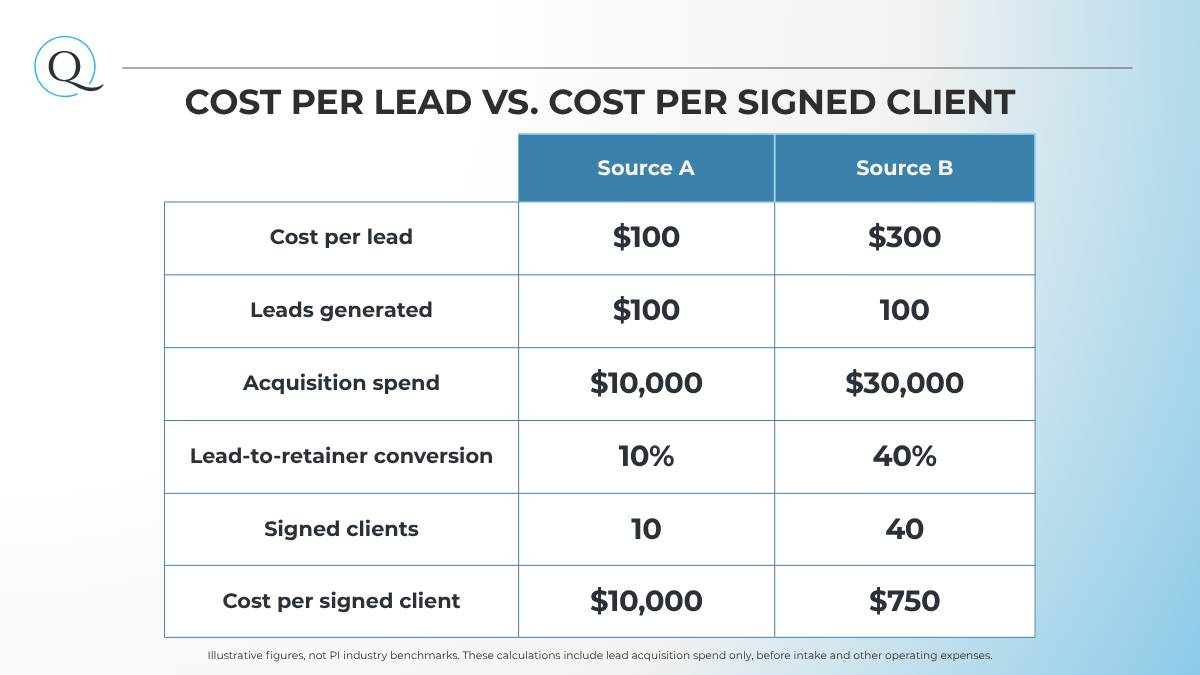
Consider two hypothetical sources, each delivering 100 leads. Source A looks like the better bargain. Source B costs three times as much upfront.
| Source A | Source B | |
| Cost per lead | $100 | $300 |
| Leads generated | 100 | 100 |
| Acquisition spend | $10,000 | $30,000 |
| Lead-to-retainer conversion | 10% | 40% |
| Signed clients | 10 | 40 |
| Cost per signed client | $1,000 | $750 |
Illustrative figures, not PI industry benchmarks. These calculations include lead acquisition spend only, before intake and other operating expenses.
Source B spends more overall, but it also delivers four times as many signed clients. At $750 per signed client, it’s $250 less expensive per acquisition than Source A.
Think about buying paint. The cheaper can isn’t necessarily the better bargain if you need twice as much paint, and twice the labor, to finish the job. The number that matters is what it costs to get the room painted, not what you paid for the can.
Of course, that doesn’t mean a $300 lead is inherently better than a $100 lead. Higher prices guarantee nothing, and these illustrative conversion rates aren’t industry benchmarks. But without retainer outcomes, a firm simply doesn’t have enough information to know which source is actually the better buy.
The Expenses Hiding Behind a Low CPL
An inquiry can require screening, multiple calls, text messages, consultations, record updates, and follow-up before a firm knows whether it will become a client. Some leads will need substantial attention and never sign. Others may arrive better qualified and require fewer steps to reach a decision.
Those differences matter financially. Consider what a firm may spend beyond the lead itself:
- People: Intake and administrative time spent qualifying, contacting, scheduling, and following up.
- Tools: CRM, communication, automation, and reporting expenses attributable to acquisition.
- Extra handling: Time spent resolving duplicate inquiries, incomplete details, or prospects who aren’t a fit.
Individually, those tasks may seem minor. Across hundreds of inquiries, they can create the hidden tax of intake chaos, particularly when a source delivers plenty of activity but relatively few signings.
A fuller cost-per-signed-client calculation can include those attributable expenses. A firm doesn’t need to pretend every overhead dollar belongs to a specific campaign, but it should use a consistent, reasonable method of allocating the costs it can identify. Otherwise, cheap leads can appear more efficient simply because someone else’s labor is missing from the report.
Use CPL and Cost Per Signed Client for Different Decisions
It would be tempting to throw CPL out entirely and concentrate on signed-client cost. That would be a mistake. Both numbers answer important questions at different points in the acquisition process.
CPL helps marketing teams understand whether campaigns are generating inquiries efficiently. Cost per signed client helps leadership decide whether those inquiries are producing business at a sustainable cost. Looking at them together can reveal whether a firm has a source problem, a conversion problem, or both.
For example, a low CPL paired with few qualified prospects may signal that the firm is paying for the wrong inquiries. If plenty qualify but few sign, the answer may lie in the handoff to intake, where lead quality becomes an operations problem.
The important thing is to compare sources using the same lead definitions, cost categories, and reporting periods. Allow enough time for prospects to move through intake, too. A campaign that launched last week and one with months of retainer outcomes aren’t ready for a head-to-head verdict.
Before You Buy More Leads, Follow the Money
When a source promises a great price, ask for more than its CPL. Look at the number of inquiries, the share that become qualified opportunities, the percentage that sign, and the acquisition cost those retainers represent. Then factor in what the firm spends to get prospects across the finish line.
Before buying more leads, review the intake metrics that link inquiries to signed retainers. Better reporting won’t automatically improve conversion, but it can keep a firm from pouring additional budget into an acquisition channel it doesn’t yet understand.
There may be excellent reasons to choose a lower-CPL source. There may also be excellent reasons to pay more upfront. The decision should come from the clients a source produces and the resources required to acquire them, rather than from the satisfaction of seeing a smaller number on a dashboard.
Want a clearer picture of what your PI client acquisition dollars are buying? Talk with Quintessa about improving acquisition quality, reducing unnecessary intake friction, and building a more predictable path to qualified, signed clients.