

Personal injury marketing used to be easier to describe. A firm invested in search, referrals, advertising, or purchased leads, then waited for the phone to ring.
That picture no longer captures how people find a lawyer or how firms turn attention into signed clients. Discovery now happens across traditional search, AI-assisted search, paid media, reviews, referrals, and other digital touchpoints. At the same time, acquisition costs are high enough that firms can’t afford to judge performance by traffic or raw lead volume alone.
We need a new question to reframe this new picture: “Which acquisition paths consistently produce qualified prospects who become retained clients?”
Discovery Is Splintering Across Search, AI, Paid Media, and Referrals
Traditional search still matters. So do a strong website, local visibility, reviews, referrals, and paid campaigns. This is all the foundation, and it’s still the core of it all. But what’s changing is how often those channels overlap before a prospect ever contacts a firm. Think of acquisition less like a straight line and more like a well-tuned engine: search, AI, paid media, referrals, intake, and follow-up are separate components, but performance depends on how well they work together.
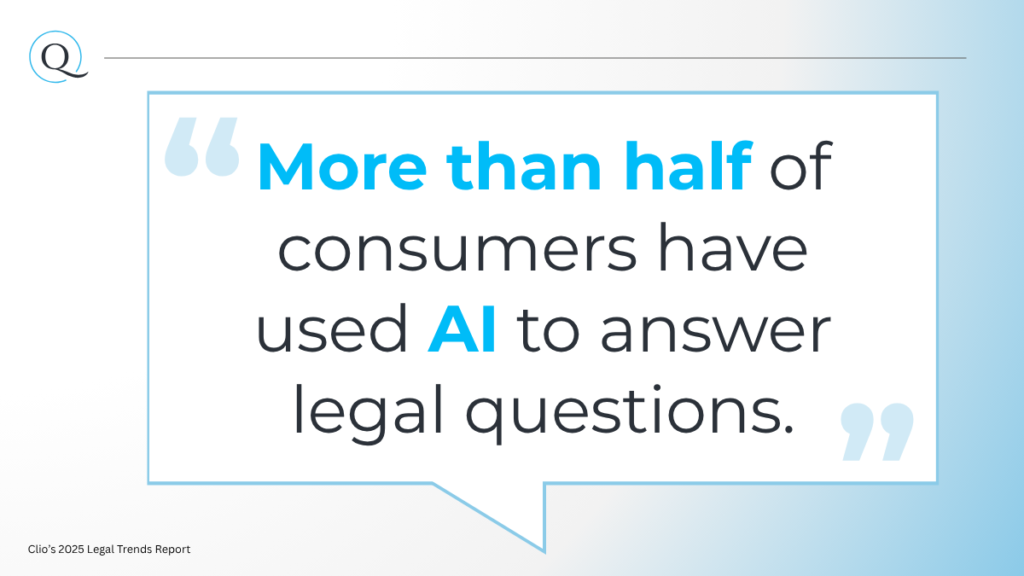
AI has added another layer to that journey. Clio’s 2025 Legal Trends Report found that more than half of consumers have used or would consider using AI to answer legal questions. Among consumers who had already done so, 28% said AI directed them to contact a lawyer.
Google’s own 2026 data shows how quickly AI-assisted discovery is moving into the mainstream. AI Overviews has more than 2.5 billion monthly active users, and AI Mode has surpassed one billion monthly users.
For PI firms, traditional search is still part of the picture. The difference is that a prospective client may reach a firm’s website after a much less linear research process. Someone might begin with an AI-generated answer, check reviews, search the firm’s name, compare websites, see a paid ad, and only then make contact. Visibility now has to account for that broader discovery environment.
Paid Media Still Works, but the Economics Matter More
Paid search remains valuable because it can put a firm in front of people who are actively looking for legal help. It’s also an expensive place to compete.
WordStream’s 2026 Google Ads benchmarks put Attorneys & Legal Services at an average cost per click of $9.87 and an average cost per lead (CPL) of $131.63, the highest CPL among the industries in its study. Those are broad legal-industry figures rather than PI-specific benchmarks, but they show the pressure firms face when buying attention.
Cost per lead is useful, but it only tells part of the story. A $100 lead that rarely qualifies or converts can ultimately cost more than a $200 opportunity that consistently becomes a retained client.
PI firms need enough downstream data to know the difference. As we’ve shown elsewhere, volume can create activity without producing efficient growth. The value of a channel actually depends on what happens after the lead enters the funnel.
Intake Is Part of Acquisition Performance
Marketing performance doesn’t end when the phone rings or a form submission enters the CRM. Response time, qualification, accessibility, follow-up, and client experience all influence whether the demand a firm paid to generate becomes revenue.
It’s easy to underestimate how much value can be lost here. In Clio’s 2024 secret-shopper study of 500 law firms, 48% were ultimately unreachable by phone and only 33% responded to email inquiries.
For a PI firm, a missed response can mean losing a prospect at the exact moment they’re actively seeking help. Adding more demand won’t solve that kind of friction for long. It can even make the problem worse if the intake team is already struggling to prioritize, qualify, and follow up consistently.
That’s why lead quality and intake operations have to be evaluated together. Some sources really are weak, but poor routing, inconsistent qualification, slow response, or incomplete follow-up can also make a viable source look worse than it is.
Attribution Has to Follow the Client Past the Lead
Lead volume and CPL describe what happened near the top of the funnel. They don’t tell firm leaders whether the investment produced what the business actually needs.
Useful attribution should follow prospects through consultation, signed retainer, acceptance, and the downstream outcomes the firm uses to evaluate growth. It should also let leaders compare conversion and cost per acquired client by source.
Frustratingly, weak performance can start in multiple places. Looking at where the breakdown occurs can help narrow the cause:
- Low-quality inquiries may point to a targeting or vendor problem.
- Strong inquiries with poor consultation rates may signal a contact or intake issue.
- Signed retainers followed by high early attrition may reveal a qualification problem.
Good attribution helps a firm diagnose the system instead of simply counting how many names entered it.
Retained-Client Economics Are Becoming the Better Growth Lens
Once a firm can see the full path, acquisition decisions get more useful. A low CPL may look attractive until weak qualification, repeated follow-ups, staff time, and poor conversion are factored in. A higher acquisition cost, on the other hand, may make perfect sense if the source consistently produces qualified people who sign, remain engaged, and fit the firm’s criteria.
At that point, marketing measurement starts to look a lot more like business performance. Instead of asking only which campaign generated the most leads, leadership can ask which sources produced the strongest retained-client outcomes at a sustainable cost.
It also makes hidden operational costs easier to see. Poor-fit volume can consume intake capacity, muddy CRM data, and create work that never had much chance of producing revenue.

What PI Firms Should Prepare for Next
Personal injury client acquisition is likely to become even more connected over the next few years. AI-assisted research will keep shaping discovery while paid channels remain competitive. Firms will need better first-party data, stronger attribution, and intake systems that leverage technology and automation without losing the human responsiveness prospective clients expect.
That also means marketing, intake, operations, and leadership need to look at performance together. Each part of the acquisition process affects the next, and a weak handoff anywhere in the system can erode value that was created upstream.
There may never be one acquisition channel that replaces everything else. Firms that understand which mix of visibility, qualification, intake, follow-up, and measurement produces the retained-client outcomes they want will be in a much better position to spend wisely and scale predictably.
Quintessa helps PI firms move closer to that outcome by focusing on qualified, signed MVA retainers rather than simply adding more names to the top of the funnel. If your firm is ready to evaluate acquisition by what it ultimately produces, let’s talk.