

The retainer is signed! Everything looks great. Then the documents don’t come back. The first follow-up gets no response, and neither does the second. By the end of the week, an intake specialist, a paralegal, and maybe a supervisor have all spent time on a client relationship that looked like a clean win just days ago.
Sound familiar? We thought so.
A signed retainer can make an acquisition source look successful before a firm knows whether that client will actually progress. When the client stalls after signing, costs continue to accumulate through additional outreach, incomplete onboarding, staff intervention, and sometimes attrition.
Of course, a slow response alone doesn’t signal weak intent. Personal injury clients may be juggling medical treatment, financial pressure, transportation problems, work obligations, and the general upheaval that follows an accident. Low intent is better understood as a pattern of weak demonstrated commitment to moving forward. When that pattern repeats across enough signed clients, what looked like an acquisition win can become a much more expensive operational problem.
The Retainer Isn’t the Finish Line
Marketing reports often treat the signed retainer as the endpoint. Acquisition spend produced a client, cost per acquired client can be calculated, and the conversion enters the win column. Operationally, though, the firm has only started investing resources in that relationship.
Onboarding, document collection, communication, recordkeeping, coordination, and follow-up all require staff time. When clients participate consistently, those workflows can function as designed. When participation drops, routine tasks start requiring additional touches, repeated requests, and more intervention from the team.
That distinction matters because acquisition cost tells only part of the story. As we’ve discussed before, a source that looks inexpensive at the top of the funnel may become far less efficient once the firm examines what it actually costs to acquire clients and keep them moving forward.
The retainer may be signed, but the firm is still spending resources on the relationship long after the ink is dry.
The Follow-Up Tax Adds Up Fast
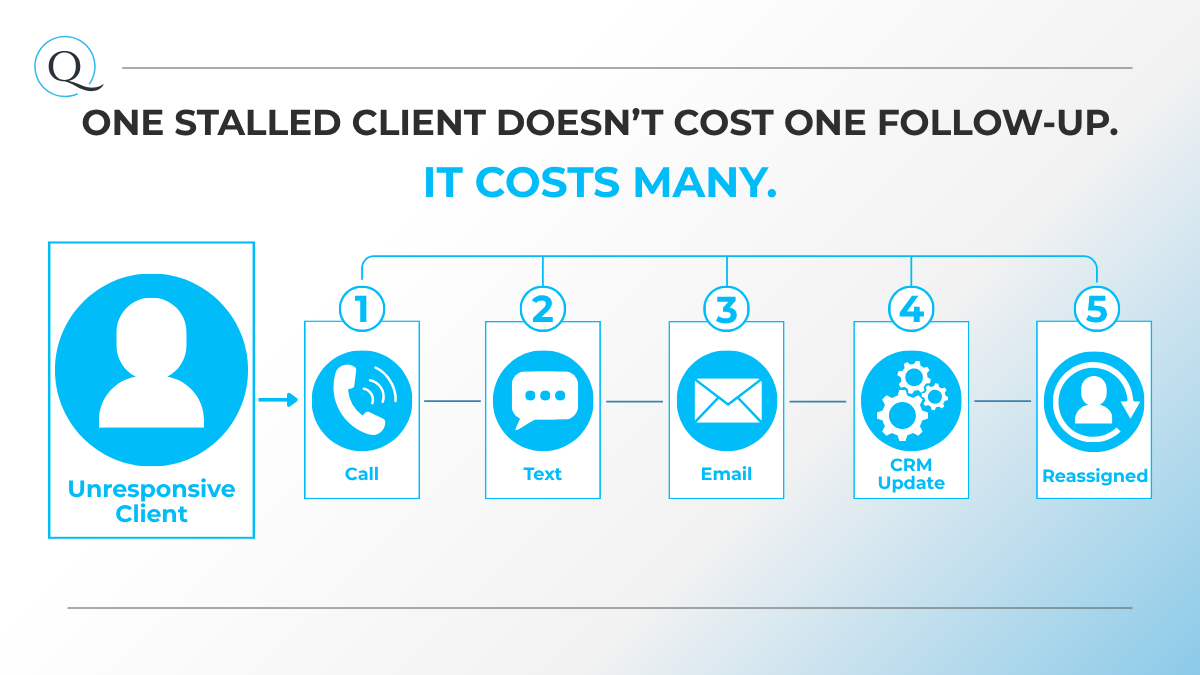
One disengaged client usually doesn’t set off alarm bells. A request for documentation goes unanswered, so someone follows up. The next call goes to voicemail, prompting a text or email. That contact attempt gets documented, someone reopens the record a few days later, and another follow-up goes out. Eventually, a supervisor may need to step in and determine whether the client is still participating.
None of those steps looks particularly alarming in isolation, which is part of what makes the problem so easy to underestimate. Multiply those extra touches across 20, 50, or 100 retained clients, however, and the workload changes quickly. Staff members spend more time reopening stalled conversations, repeating requests, documenting unsuccessful outreach, and deciding what happens next while responsive clients and stronger incoming opportunities still need attention.
At scale, the strain shows up in capacity. Intake teams have a finite amount of time and attention, and repeated follow-up consumes both. An American Bar Association Law Practice article notes that incomplete forms, missed callbacks, repeated administrative handoffs, and other intake friction can compound into larger operational problems. It also cites research indicating that one in three prospects may abandon onboarding when the process feels too slow or complicated.
The takeaway isn’t to push injured clients through the process faster. Firms need to understand where friction is accumulating, how often staff members are having to compensate for it, and whether certain acquisition sources generate more of that work than others.
When an “Affordable” Retainer Gets Expensive
The economics change again when a client disengages entirely, leaves the firm, or otherwise fails to progress after signing. By that point, the acquisition cost has already been paid, intake resources have been used, and onboarding and follow-up may have consumed additional staff time.
If source performance is evaluated primarily by cost per signed retainer, however, the acquisition may still look successful on paper. A source producing lower-cost signed clients can become a weaker investment when those clients repeatedly stall or leave after acquisition. Another source may cost more upfront while producing stronger downstream economics because its clients participate consistently and remain with the firm.
One client dropping out proves very little; patterns tell the more useful story. Firms need enough visibility to see whether particular acquisition sources repeatedly produce more post-signature fallout, added follow-up demands, or incomplete onboarding. Without that visibility, apparent acquisition efficiency can hide what the firm is actually spending to turn those signatures into productive client relationships.
Your Staffing Problem Might Not Be a Staffing Problem
Low intent can also affect decisions well beyond marketing. Signed-client volume often informs staffing, resource allocation, workload projections, and revenue forecasts. When a meaningful portion of those clients requires disproportionate attention or fails to progress, leadership may be planning around a client population that behaves very differently from what the headline number suggests.
An overwhelmed intake team can easily look like a headcount problem. In some firms, additional staffing may absolutely be necessary. In others, part of the workload is being created by repeated communication attempts, incomplete onboarding, stalled relationships, and clients who require significantly more intervention than expected.
Understanding that difference matters before a firm adds staff or increases acquisition spend. When teams are already spending substantial time managing post-signature friction, adding more volume can increase the burden without addressing the source of it.
Reporting can create a similar blind spot. If firms don’t consistently connect acquisition source, qualification, signed-retainer status, and downstream outcomes, the CRM may show plenty of activity without explaining which sources are actually producing sustainable client relationships.
Look for Intent Before the Ink Is Dry
Traditional qualification criteria help determine whether a prospective client appears viable based on factors such as geography, accident type, injury indicators, and other firm-specific requirements. Intent becomes clearer through what the prospect actually does during the intake process.
Has the prospect answered necessary questions? Confirmed important details? Participated in follow-up? Demonstrated that they understand why they’re speaking with the firm and want representation? Those behaviors give the firm additional information about how actively the prospect is participating before the relationship reaches the signed-retainer stage.
No screening process can predict every future communication problem, nor should firms expect one to. Meaningful participation before signing simply gives the firm additional evidence that the prospective client intends to move forward afterward. That can support smoother onboarding, cleaner handoffs, and more predictable use of staff capacity.
Follow the Client, Not Just the Signature
A clearer picture of acquisition performance requires source evaluation to continue after the retainer. Firms can start by asking a few practical questions:
- Which sources produce clients who complete onboarding?
- Which sources produce clients who remain engaged and continue progressing?
- Where is early attrition occurring most often?
- Which clients require disproportionate follow-up or staff intervention after signing?
- Are those patterns concentrated around particular acquisition sources?
Those answers turn post-signature friction into information leadership can actually use. If one source consistently produces clients who require repeated outreach, leave documentation incomplete, or disengage shortly after signing, that pattern belongs in acquisition-performance reporting rather than living solely as an intake-team frustration.
Firms should also compare sources based on downstream economics instead of signed-retainer cost alone. A lower acquisition cost loses some of its appeal when the relationship that follows requires substantially more staff time or repeatedly ends in early attrition. Following the client beyond the signature gives leadership a better view of what each acquisition source is actually producing.
Better Intent Starts Before the Handoff
Low-intent clients can consume staff capacity, increase acquisition costs, distort reporting, complicate staffing decisions, and weaken the forecasts leadership uses to plan growth. No firm can eliminate every stalled relationship, particularly when clients are dealing with injuries and the disruption surrounding them. The goal is to identify patterns early enough to make better decisions about the opportunities the firm acquires, the sources it invests in, and the workload it asks its team to absorb.
Quintessa Marketing focuses on qualified, intake-ready opportunities and signed retainers from prospects who have already participated meaningfully in the intake process. That gives firms more information about client intent before the relationship reaches their team, creating a stronger starting point for onboarding and continued engagement.
If your firm is signing clients but spending too much time trying to keep them engaged, some of that friction may begin before the retainer. Connect with our team to talk about how stronger qualification and demonstrated pre-retainer intent can support better downstream outcomes for your firm.