
Many personal injury firms compare lead sources the same way consumers compare products: by looking at the price tag. (AKA: the price per lead.) At first glance, that makes sense. If a shared lead costs $75 and an exclusive lead costs $300, the shared lead looks like the better deal. Lower cost, simple enough.
But lead acquisition isn’t a retail purchase. The true cost of a lead isn’t determined at the point of sale, like a printer or a new coffee machine for the office. It’s determined by what happens after it enters your firm’s intake process. That process asks several questions, and the answers are where the real calculations begin.
Does the lead answer the phone, schedule a consultation, sign a retainer, and become a viable case? Are they actually qualified? How much staff time is required to get them there? And perhaps most importantly, how many other firms are pursuing that same lead?
Those questions often matter more than the upfront price.
Shared and exclusive leads aren’t just priced differently — they work differently. They create different operational demands, conversion challenges, and economics. So the better question isn’t whether your firm is paying more or less for a lead. It’s what they’re actually paying for: a name in a database, a race against competitors, a real conversation, a genuine opportunity, or a signed client.
The Basic Difference Between Shared and Exclusive Leads
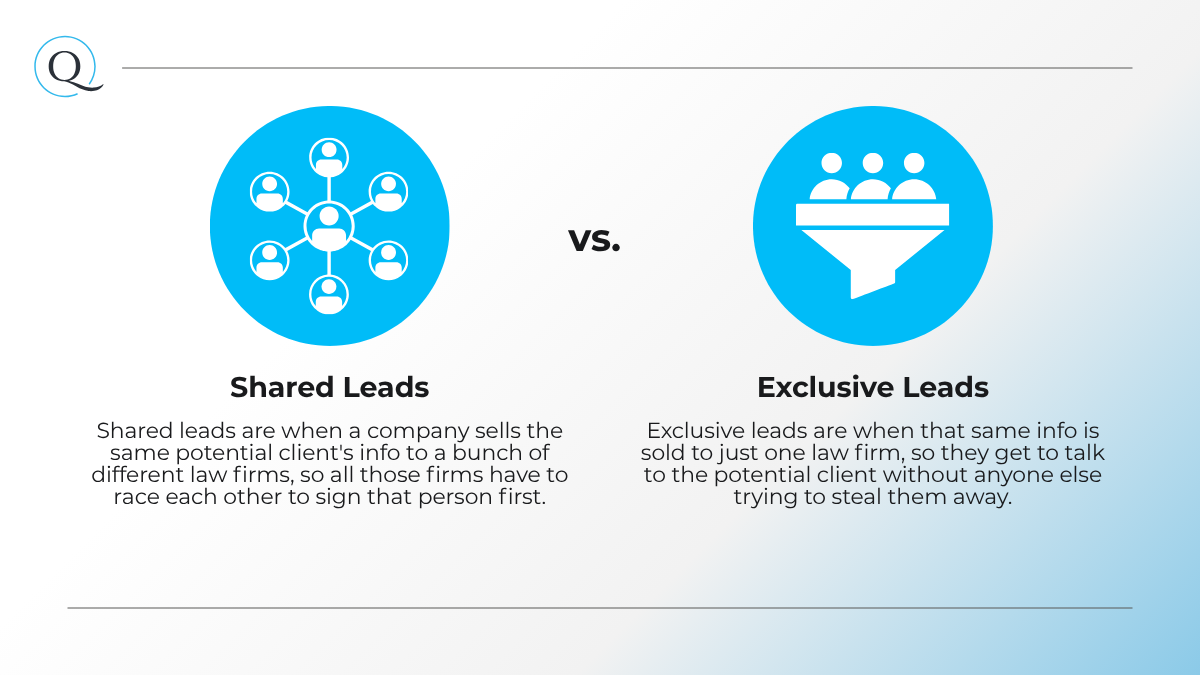
Shared and exclusive leads are separated by one simple question: Is your firm competing for the opportunity, or receiving it alone?
Shared Leads
Shared leads are distributed to multiple law firms. Because the provider can sell the same inquiry multiple times, the cost per lead (CPL) is typically lower. However, that lower price comes with an obvious tradeoff: competition. Several intake teams may be contacting the same prospective client at nearly the same time. In many cases, the first meaningful conversation has a significant impact on who ultimately earns the opportunity to represent that client.
Exclusive Leads
Exclusive leads are sold to one firm and one firm only. Since the lead provider can’t sell the same inquiry multiple times, the tradeoff is that the upfront cost is typically higher. But what the firm gets in return is a shot at the client without anyone else in the race. That gives intake teams an advantage with everything from first screening to ongoing communication.
Clearly, both approaches can be successful, but the more important thing to consider is how each model performs inside your firm’s intake system. A high-performing intake team may convert shared leads efficiently. A poorly managed intake process may struggle with exclusive opportunities despite having less competition.
While the lead model matters, your internal systems matter even more.
Why Lower Upfront Cost Can Hide Worse Economics
CPL is one of the easiest metrics to measure. It’s also one of the easiest metrics to misunderstand.
Suppose a firm purchases ten shared leads at $75 each. The total investment is $750. Another firm purchases three exclusive leads at $300 each. The total investment is $900.
At first glance, the shared-lead strategy appears way more efficient because it generates more opportunities for less money. But what happens next? The firm’s true acquisition cost is not determined by the lead price. It’s determined by how many qualified prospects ultimately become retained clients.
And that’s where hidden costs emerge:
- Intake spends time on prospects already speaking with competing firms
- More follow-up attempts may be necessary
- Consultation rates can decline as prospects get multiple outreach attempts
- Staff time is used on leads that never progress or convert
A lower-priced lead is only more affordable if it produces comparable results. Otherwise, your firm may be paying less per lead while paying more per signed client. Possibly much more.
Shared Leads Create Response-Time Pressure
With shared leads, speed isn’t just helpful; it’s crucial. When multiple firms are receiving the same inquiry, the one that responds first has a real leg up. If you wait a few hours to reach out, there’s a good chance that the prospective client has already had a conversation with someone else.
Unfortunately, recent research examining more than 1,300 law firm websites found that only 25% of firms responded to online inquiries within five minutes, while 39% either took more than two hours to respond or failed to respond at all. The study also found that 26% of firms never responded to online inquiries during the testing period.
For firms relying heavily on shared leads, this creates operational pressure:
- Intake teams must respond fast
- Missed calls are more costly
- Follow-up windows are shorter
- Staffing requirements may increase
- After-hours coverage becomes crucial
But speed only gets you so far. A fast response can’t make up for weak qualification criteria, an overwhelmed intake team, or a lead that was never a great fit to begin with. It matters, but only as a piece of the overall puzzle.
Competition Can Erode Margin
Even more than conversion rates, competition affects effort. When several firms are pursuing the same potential client, your intake teams may need to spend more time establishing trust, answering questions, and differentiating your firm from competitors.
At a stressful time, leads may receive multiple calls, texts, emails, and consultation offers within a short period, all of which can create additional costs for your firm:
- More time spent on each lead
- More follow-ups required
- Greater pressure to engage quickly
- Less control over the client’s first impression
- Increased staffing demands
Competition can increase the resources required to turn a conversation into a conversion.
This is one reason firms should evaluate lead sources based on operational efficiency, not just volume. It’s getting across the finish line that creates value for your firm, and a source that generates fewer inquiries but requires less effort per signed client may ultimately lead to crossing that finish line.
Exclusive Opportunities Are Easier to Operationalize
Exclusive opportunities can reduce some of the operational complexity that comes with a shared lead approach. Without direct competition from other firms purchasing the same lead, intake teams typically have more flexibility to work the opportunity within their established workflows.
This can create several advantages:
- Cleaner lead routing and ownership
- More consistent follow-up processes
- Better CRM tracking/clearer attribution
- Less wasted intake activity
Perhaps most importantly, exclusive opportunities often create better alignment between marketing, intake, and business-development goals. Your firm isn’t simply trying to win a race. You can focus on determining whether the opportunity is a good fit and guiding the prospective client through a structured intake experience that sets both you and them up for a positive outcome.
That doesn’t guarantee higher conversion rates. But it often creates a cleaner process for measuring and improving performance.
The Real Question Is Cost Per Signed Case
We’ve established that lead volume matters, and CPL matters. But neither metric tells the full story.
Firms that want to understand the performance of a lead source need to evaluate the entire conversion funnel, including contact rate, consultation booking rate, the cost of each signed case, and overall lead source profitability. These are the metrics that reveal whether a source is generating activity or generating bottom-line profit.
Let’s say Company A delivers fewer leads each month than Company B, but consistently produces qualified consultations and signed retainers. Company B generates higher volume, but the inquiries create significant intake workload without the corresponding results. This is where many firms discover that their best-performing lead source is not necessarily the one generating the most leads. It’s the one generating the most profitable clients.
When Shared Leads Make Sense
That said, shared leads can absolutely be a viable part of a growth strategy — the challenges are real, not insurmountable. Plenty of firms use them successfully, just with the right pieces in place. They tend to work best when intake coverage is strong, response times are consistently fast, and there’s a clear process for qualifying leads quickly.
So for firms with mature intake operations in markets that can withstand competition, shared leads can provide access to significant opportunity volume at a manageable acquisition cost. The key is understanding what the firm must do operationally to compete effectively.
Shared leads are not inherently inefficient. They simply require a different approach to intake, staffing, and follow-up.
What PI Firms Should Ask Before Buying Any Lead Source
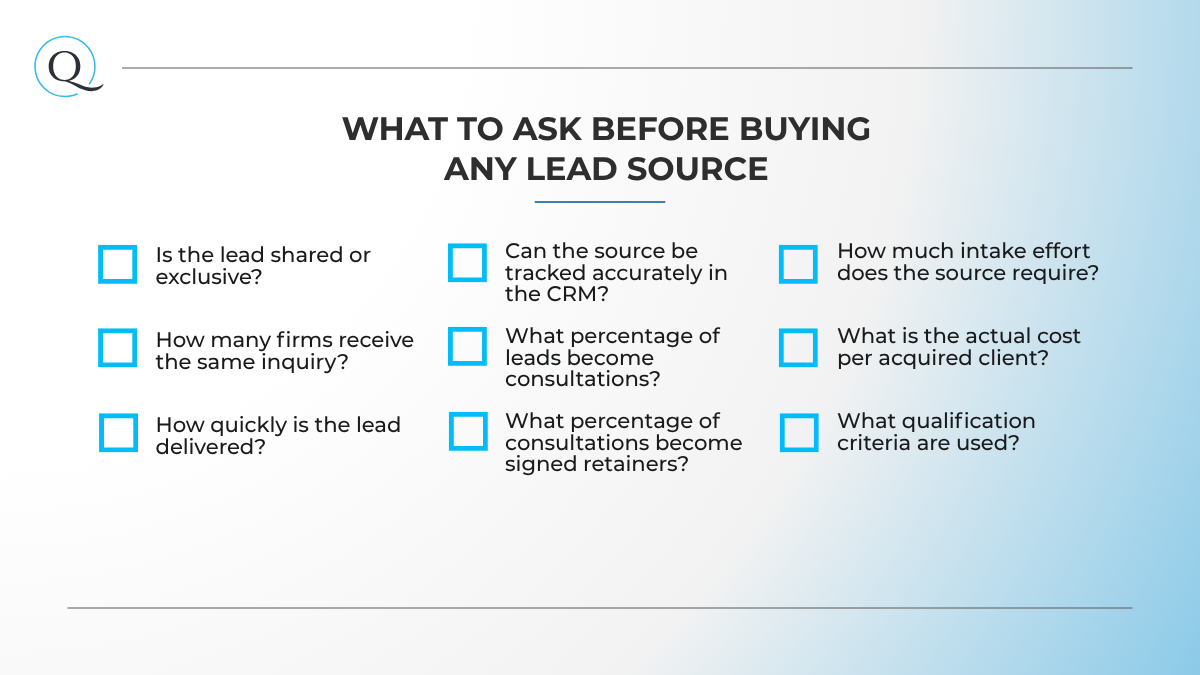
Before investing in any lead source, firms should ask the practical questions that shift the conversation away from lead price and toward business performance:
- Is the lead shared or exclusive?
- How many firms receive the same inquiry?
- How quickly is the lead delivered?
- What qualification criteria are used?
- Can the source be tracked accurately in the CRM?
- What percentage of leads become consultations?
- What percentage of consultations become signed retainers?
- How much intake effort does the source require?
- What is the actual cost per acquired client?
The goal is not to purchase leads. It’s to acquire clients efficiently, predictably, and at a rate that helps you scale.
Shared vs. Exclusive Leads: Focus on Outcomes, Not Price
Shared leads come with tradeoffs: competition, response-time pressure, and extra work on the intake side. Exclusive leads give you more control, cleaner attribution, and a simpler path to conversion. But neither is a guaranteed win.
The firms that consistently grow are the ones that understand how each lead source performs across the entire funnel, from first contact to signed retainer. When firms focus on cost per signed case instead of CPL, they gain a much clearer picture of what is actually driving growth.
Want to understand which lead sources are actually turning into signed cases? Connect with us to learn how costs per signed case are the acquisition measurement you need to master.