
Every business pays taxes. Some go to the county, some to the IRS. But the tax sneaking past you might be hidden in your pipeline.
For many personal injury firms, intake chaos charges a tax they never signed up to pay. And the costs start well before anyone signs a retainer.
Every inquiry leaves something behind, even when it goes nowhere. Maybe it’s a phone call that didn’t connect. Maybe it’s a CRM record that needs to be updated, another follow-up email, or a note explaining why the lead wasn’t qualified. None of those tasks takes much time by itself. Together, they can quietly crowd out the work that matters most.
When too many low-quality inquiries enter the same workflow as qualified opportunities, firms begin paying a hidden operational tax. It shows up in cluttered CRM data, slower follow-up, heavier workloads, and less confidence in the reports leaders rely on to make decisions.
The cost is not only lower conversion. It’s everything the firm spends before conversion ever has a fair chance to happen.
Poor Lead Filtration Sets the Stage for Intake Chaos
Lead filtration is the process of deciding which inquiries deserve deeper intake attention and which should be screened out earlier. Effective filtration looks at factors such as case type, geography, injury indicators, contactability, and other qualification criteria before every inquiry enters the same workflow.
Without those guardrails, everything ends up in the same pile. Duplicate records, incomplete submissions, poor-fit inquiries, and people who never answer the phone all compete for the same time and attention as legitimate opportunities. That’s where the hidden tax starts to show.
Your intake teams don’t create the problem. They just inherit it. Even experienced teams can only work with the quality of what’s placed in front of them.
Stronger filtration gives those teams a better starting point. When qualification criteria are applied before an opportunity reaches the primary intake queue, staff can spend less time separating signal from noise and more time moving qualified prospects toward a consultation.
CRM Noise Hides What Is Actually Working
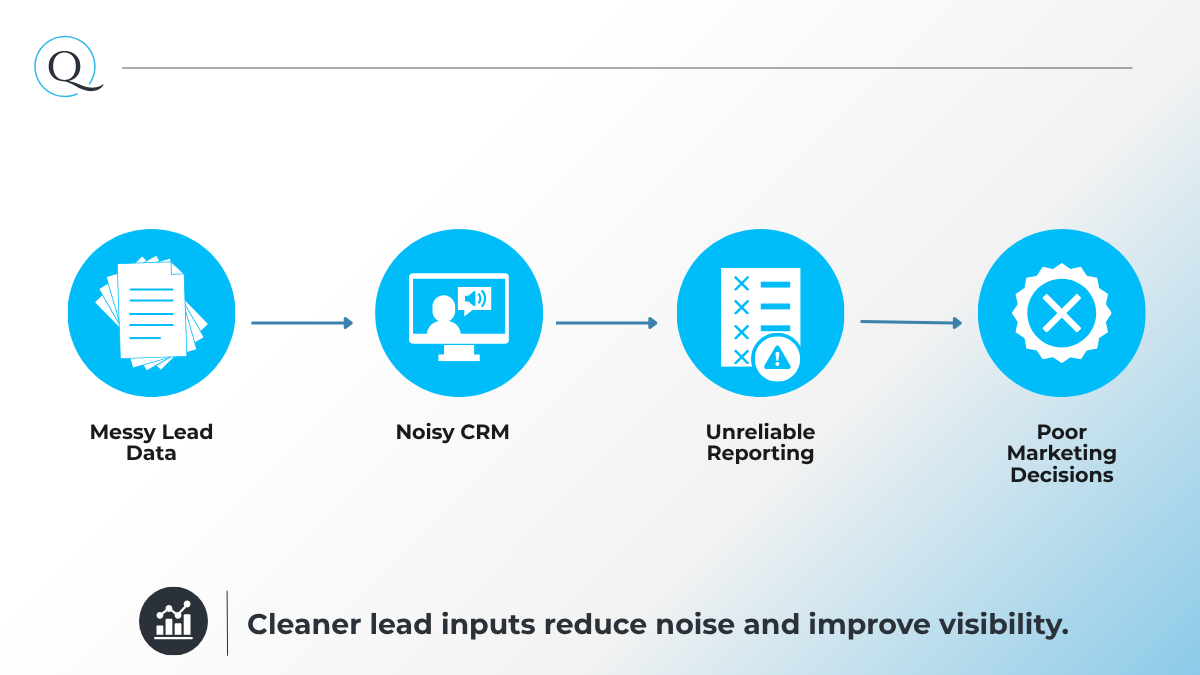
No intake team loses sleep over a single duplicate record. One missing lead source or incomplete submission isn’t a disaster either. The problem is accumulation. As those small issues pile up, they quietly make the CRM less useful.
When the data gets messy, the reports follow. Duplicate contacts, vague disqualification notes, incomplete records, and inconsistent status updates make it harder to understand which marketing efforts are producing signed retainers and which are simply creating more work.
Eventually, leadership is trying to interpret performance data, not just review it. And when the data itself becomes unreliable, it’s much harder to know which marketing investments are producing qualified opportunities and which are simply generating activity.
Without clear distinctions between outcomes, firms may spend more on channels that generate activity rather than revenue and pull back from sources producing stronger results.
Cleaner lead inputs won’t solve every CRM problem, but they can reduce incomplete and poorly matched records. When lead source, qualification status, and intake details are captured consistently, reporting becomes easier to trust and performance easier to compare.
Follow-Up Breaks Under Low-Quality Volume
Every inquiry creates follow-up work, even if it never becomes a client.
Calls still need to be returned. Emails still need to be sent. Notes still need to be documented. Missing information still needs to be requested. The challenge isn’t that intake teams stop working hard. It’s that low-quality volume asks them to work hard on the wrong things.
Clio’s 2024 Legal Trends Report found that many firms still struggle to respond consistently to prospective clients. When qualified opportunities are competing for attention alongside large volumes of poor-fit inquiries, maintaining fast, consistent follow-up becomes even more difficult.
The hidden tax grows again. Not because good leads disappear, but because they become harder to correctly prioritize.
The Staff Productivity Cost Is Bigger Than It Looks
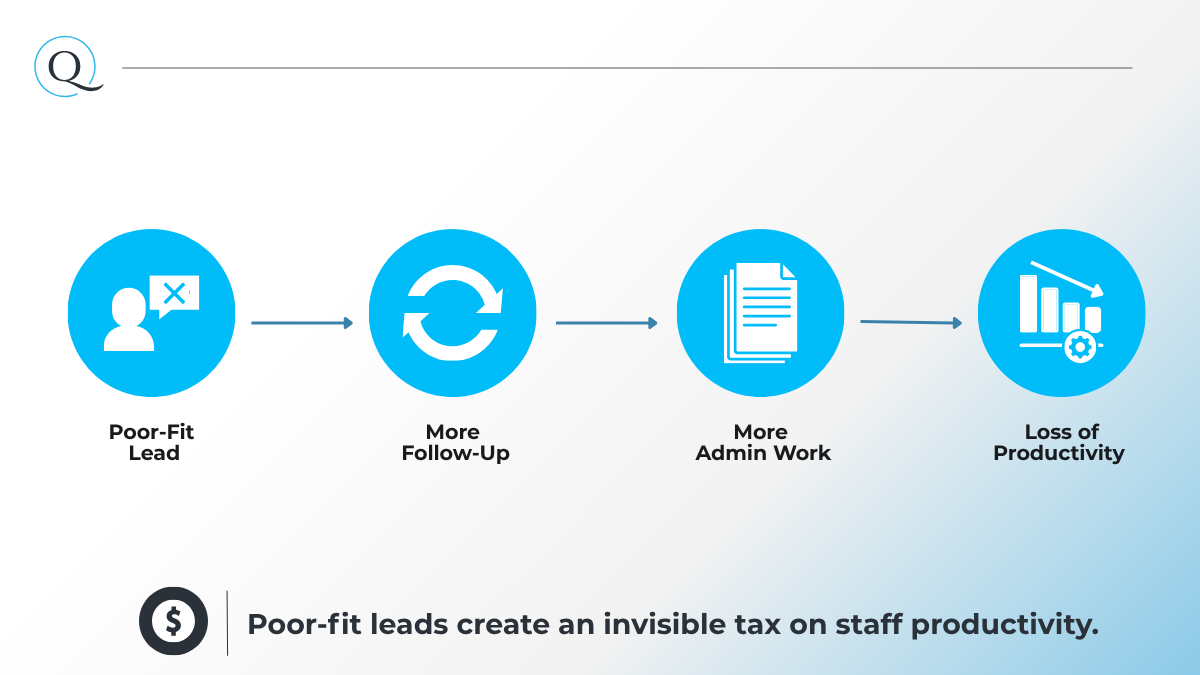
Poor-fit leads rarely require just one touch. A voicemail leads to another call. A missing document requires another email. A duplicate record needs to be merged. A file needs to be routed, updated, and eventually closed.
Each task is small enough to ignore on its own. Together, they become a steady drain on the day. Staff spend more time updating records, following loose ends, and closing files that never had much chance of becoming clients. By the end of the week, it’s easy to conclude the department needs more people, when the real problem may be that too much time is being spent on low-quality inquiries.
Sure, sometimes you do need more people. Other times, the real opportunity is reducing the amount of unnecessary work entering the system in the first place.
Intake Chaos Compounds Silently Over Time
Nobody wakes up one morning and decides to make the intake process more complicated. It happens a little at a time. Teams create workarounds. Reports need more explanation. Dashboards raise more questions than they answer. After a while, those extra steps stop feeling temporary and simply become part of the job.
Eventually, the solution seems obvious: buy more leads or expand the intake team. But if poor filtration remains unchanged, those investments may simply increase the amount of operational debt flowing into the business.
The more sustainable solution begins upstream. Improving the quality of what reaches the intake queue can reduce the need for downstream workarounds and mitigate that invisible tax.
What Cleaner Lead Filtration Should Make Visible
The goal of better filtration isn’t to reject more inquiries, but rather to create clearer visibility.
A healthy intake process should distinguish between raw inquiries, qualified opportunities, consultations, and signed retainers. It should consistently capture lead source, qualification status, disqualification reasons, consultation outcomes, and retainer outcomes.
When those fundamentals are in place, firms gain something more valuable than cleaner reports. They gain confidence that the numbers they’re reviewing reflect reality rather than administrative noise.
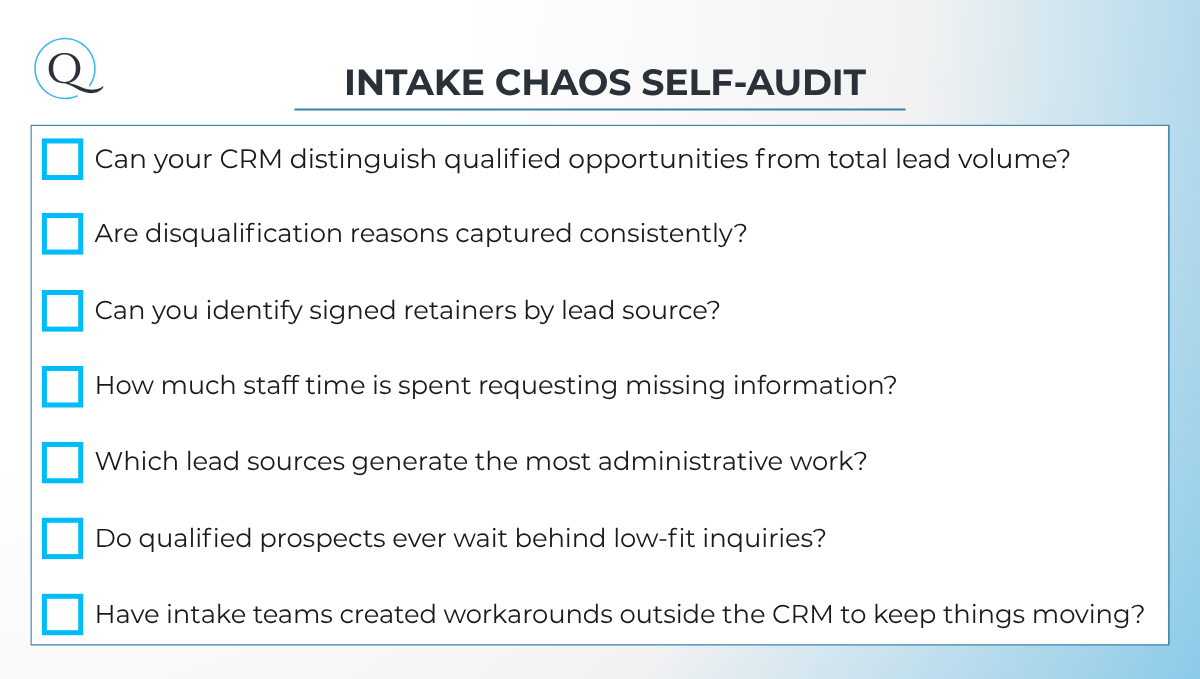
A Simple Intake Chaos Self-Audit
If your intake process feels busier than ever, ask a few simple questions:
- Can your CRM distinguish qualified opportunities from total lead volume?
- Are disqualification reasons captured consistently?
- Can you identify signed retainers by lead source?
- How much staff time is spent requesting missing information?
- Which lead sources generate the most administrative work?
- Do qualified prospects ever wait behind low-fit inquiries?
- Have intake teams created workarounds outside the CRM to keep things moving?
The more difficult these questions are to answer, the more likely your firm is paying an operational tax that’s difficult to see, but impossible to avoid.
Quality Is an Operational Strategy
Too often, lead quality is viewed as a marketing concern. In reality, it’s just as important to the way a firm operates.
Cleaner lead filtration helps protect intake capacity, improves reporting confidence, and allows teams to spend more time engaging qualified opportunities instead of sorting through unnecessary noise. It won’t eliminate every operational challenge, but it gives firms greater control over where time, attention, and resources are invested.
The hidden tax of intake chaos isn’t inevitable. Much of it can be reduced by improving what reaches the intake queue in the first place.
If you’re looking to create a cleaner personal injury intake process — not just generate more inquiries — let’s discuss how Quintessa can help your firm with qualified, intake-ready opportunities that support clearer reporting, stronger workflows, and more predictable signed-retainer outcomes.