

The issue sounds simple enough: “We need more leads.”
But before your personal injury firm increases its lead budget, adds another vendor, or pushes more volume into your intake team’s queue, someone should be able to answer a harder question: What happened to the leads your firm already paid for?
Buying more leads doesn’t automatically create growth. It does multiply whatever is already happening inside a PI firm’s client acquisition process. If the pipeline is healthy, more volume may help the firm scale. But if the pipeline is leaking, more volume could be more money down the drain.
Lead volume and cost per lead can tell a firm how much activity is coming in, but that’s only a small part of the story. The more useful information is about what happens next:
- Do those inquiries turn into consultations?
- Do those consultations become signed retainers?
- How long does that take?
- And what did the firm actually spend to get there?
If your eyes glaze over when you read terms like, “lead-to-consultation” or “consultation-to-retainer rate,” this is the article for you. Because before your firm spends more to generate demand, you need a clear view of what your current demand is producing.
Lead-to-Consultation Rate: Are Your Leads Viable?
Lead-to-consultation rate measures the percentage of leads that become scheduled or completed consultations. It is one of the first intake KPIs a personal injury firm should review before deciding whether it has a lead volume problem.
A weak lead-to-consultation rate may point to multiple issues: poor-fit inquiries, slow intake response, leads in a state where you’re not licensed, etc. This metric helps answer a practical question: Are the leads coming in worth the time and attention required to move them forward?
More leads are useful only if enough of them are viable enough to become real conversations. The better first move may be to improve source criteria, tighten qualification, speed up response, or review how leads are routed and followed up.
Consultation-to-Retainer Rate: Make Each Opportunity Count
Consultation-to-retainer rate measures the percentage of consultations that result in signed retainers. This metric helps a firm understand whether the people reaching consultation are truly aligned with the firm’s criteria and whether the post-consultation process is working.
A strong consultation-to-retainer rate usually means the firm is getting the right people to the right point in the process. In other words, the firm is spending time on people who are more likely to fit its practice area, geography, injury criteria, and business goals.
Quintessa’s benchmark framework identifies an 80%+ consultation-to-retainer rate as a target for well-qualified leads. That’s a hard KPI to reach if the firm is just pushing as many inquiries as possible into consultation without a disciplined qualification process.
But a lower consultation-to-retainer rate doesn’t automatically mean the intake team is the problem. Sometimes it means too many poor-fit prospects are getting too far into the process. If qualification is the issue, buying more leads from the same source may create more appointments, not necessarily more signed clients.
Whole Funnel Insight with Overall Conversion Rate
Overall conversion rate shows how many total leads become signed clients. It connects the dots between inquiry, consultation, and retained-client outcome.
That’s where lead volume starts to tell a fuller story. A source may send plenty of inquiries and still fall short where it matters most: producing signed clients.
The benchmark framework contrasts industry-average conversion around 7% with higher-quality pipeline conversion rates in the 55-65% range. The point is not that every firm should expect the same performance from every source. The point is that firms need to evaluate conversion all the way through the funnel, not just at the inquiry stage.
Overall conversion is most useful when firms look at it source by source. Campaign, geography, matter type, and intake workflow can all change the story.
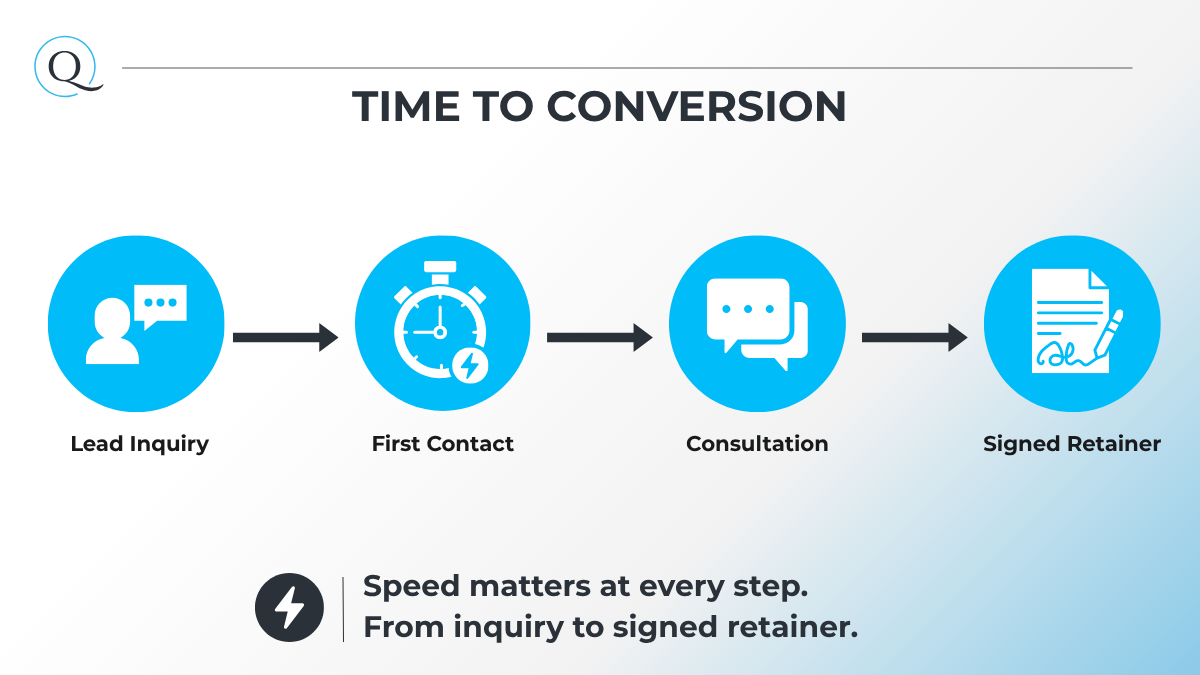
Time to Conversion: Start Your Stopwatch
Time to conversion tracks how long it takes for a lead to become a signed retainer. And in personal injury marketing, speed matters.
Prospective clients are often making decisions quickly. They may also be talking with more than one firm. The firm that responds quickly, follows up clearly, and keeps the process moving is in a better position to earn the retainer.
A slow conversion timeline can point to friction in the intake process. This metric becomes more useful when it is broken into smaller parts:
- Time to first contact
- Time from inquiry to consultation
- Time from consultation to signed retainer
- Number of follow-up attempts before conversion or disqualification
If it already takes too long to move a qualified prospect from inquiry to signed retainer, adding more leads is not always the answer. It can put more pressure on an intake team that is already stretched, which may slow response times and make follow-up even harder to manage.
Before increasing spend, firms need to know whether their current process can keep good prospects moving.
Cost Per Acquired Client Is the Real Price of Growth
Cost per acquired client shows what the firm actually spent to sign a client, not just generate an inquiry. That makes it a better growth metric than cost per lead alone.
This is where the math can change the story. A low-cost lead source may look efficient at first, but if only a small number of those leads convert, the firm may be paying more per signed client than it realizes. A higher-cost source may look expensive on the front end, but if more of those prospects become consultations and signed retainers, it may be the better investment.
The question is not only, “What did the lead cost?” The better question is, “What did it cost to sign the client?”
This is why firms should be careful about increasing spend based on CPL alone. A source can look affordable at the top of the funnel and still be inefficient once the firm calculates what it actually cost to acquire each signed client.
Before buying more from any source, firms should know whether that source produces retained-client outcomes at a sustainable cost.
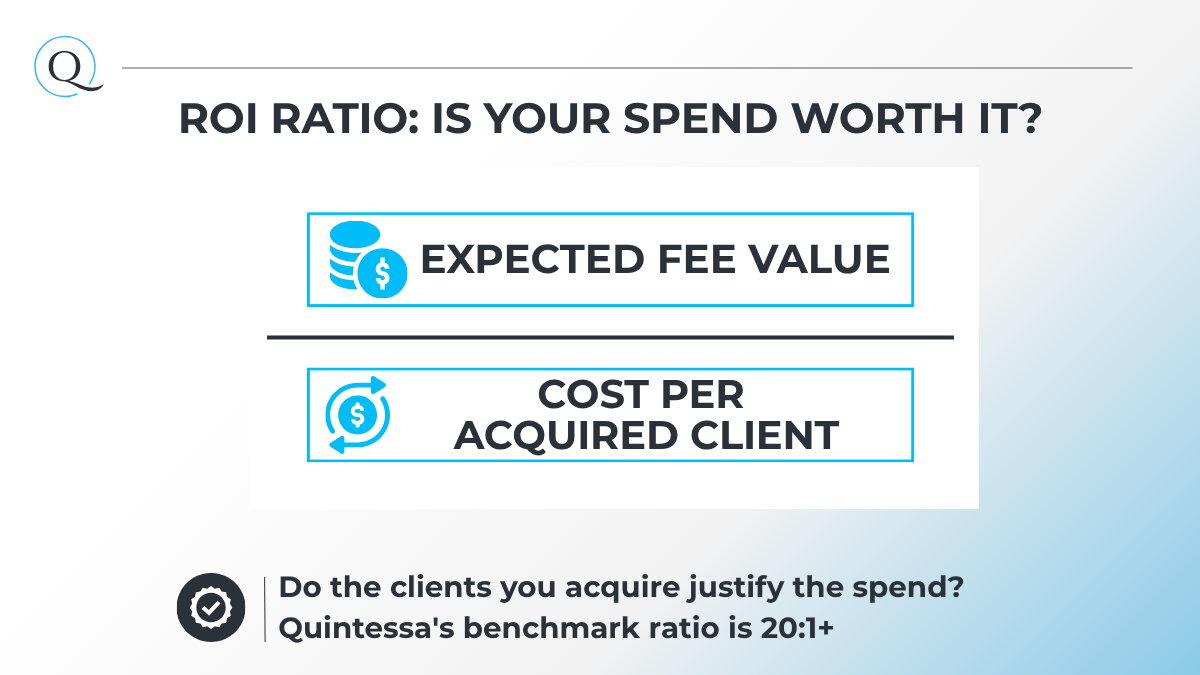
See If Your Spend Is Worth It With Your ROI Ratio
ROI ratio measures whether the value of acquired clients justifies the cost required to acquire them. A basic way to evaluate it is to compare expected fee value against cost per acquired client.
This metric moves the conversation beyond “How many leads did we buy?” and toward “Did the clients we acquired justify the spend?”
Quintessa’s benchmark framework identifies 20:1 or higher as a target ROI ratio. To use this metric responsibly, firms should work from realistic fee assumptions and segment performance where possible. Not every personal injury matter carries the same economics, and not every source produces the same mix of opportunities.
ROI ratio can help leadership decide whether a source is worth expanding, testing further, adjusting, or cutting. It can also reveal when conversion looks acceptable on paper, but acquisition economics are not strong enough to support scale.
A campaign should not be judged only by activity or even by signed-client count. It should be judged by whether those signed clients support the firm’s growth goals at an acceptable cost.
How to Read These Metrics Before Increasing Lead Spend
No single KPI can tell a firm everything it needs to know. The real value comes from looking at the numbers together and seeing what story they tell.
For example, high lead volume with a low lead-to-consultation rate may mean the source is sending poor-fit leads, or that prospects are hard to reach. A strong lead-to-consultation rate with a weak consultation-to-retainer rate may mean the firm is getting people into conversations, but too many of those prospects are not the right fit by the time they get there.
The pattern can look different from source to source. Strong conversion with a high cost per acquired client may mean the source works, but not efficiently enough to scale without a closer look. A strong consultation-to-retainer rate with low lead volume may point to a source worth testing more carefully.
That’s why these metrics are most useful as a group. They help firms see whether the next move should be more spend, better qualification, faster follow-up, a different vendor conversation, or a shift in budget.
Before increasing lead spend, PI firms should be able to answer a few basic questions:
- Which sources produce the highest lead-to-consultation rate?
- Which sources produce the strongest consultation-to-retainer rate?
- What is the overall conversion rate by source?
- How long does it take to move from inquiry to signed retainer?
- What does each acquired client cost by source?
- Which sources produce the strongest ROI ratio?
- Where are qualified prospects dropping out?
- Are disqualification reasons tracked consistently in the CRM?
These questions help firm owners and intake leaders make better decisions. The answer may be to buy more leads. It may also be to improve qualification, reallocate budget, adjust vendor criteria, strengthen follow-up, or address intake workflow gaps before adding more volume.
Measure Before You Buy More
More leads can help your personal injury firm grow, but only when you understand what is happening to the leads you already have. Lead volume and CPL show only part of the picture. Lead-to-consultation rate, consultation-to-retainer rate, overall conversion, time to conversion, cost per acquired client, and ROI ratio give a clearer view of what’s really going on in your pipeline.
For PI firms ready to move beyond noisy lead volume, Quintessa helps create a clearer path from inbound demand to qualified retainers through intake-professional vetting, full-funnel follow-up, and delivery methods that support more confident action by the firm.
Before buying more leads, measure the path from inquiry to outcome. That’s where smarter growth decisions begin. Let’s connect and put Quintessa to work for you with measurable quality, not just quantity.