

It isn’t fair, but it’s true. A personal injury firm may see plenty of inquiries, a reasonable cost per lead, and activity in the CRM, yet still struggle to produce predictable signed retainers. Sound familiar?
The problem often becomes visible when pressure hits one part of the system. Intake may be short-staffed, ad costs may rise, follow-up may slow, or conversion may slip by a few points. That’s when a source that looked healthy at the top of the funnel may prove far less reliable at the bottom.
A lead source stress test shows whether your sources can withstand pressure or simply add to it. Instead of judging performance by volume alone, firms evaluate how consistently each source produces qualified opportunities, manageable intake demands, and measurable signed-retainer outcomes when staffing, costs, volume, or follow-up conditions become less than ideal.
Why PI Lead Pipelines Are Often More Fragile Than They Look
A fragile pipeline doesn’t always look broken from the outside. In many firms, the early numbers appear healthy. Leads are arriving, the phones are ringing, and intake is busy.
But as mentioned above, the warning signs usually appear further down the funnel.
Signed retainers may swing sharply from month to month even when lead volume looks consistent. Cost per lead may look attractive while cost per retained client keeps climbing. Intake teams may spend too much time chasing low-fit, incomplete, duplicate, or unqualified inquiries. CRM reports may show activity without making it clear which sources actually produced retained clients.
That kind of confusion means you could be making growth decisions based on flawed reporting. If the data stops at lead count, you may find yourself investing more in a source that creates workload without reliable signed outcomes.
Stress Test #1: Model a Small Conversion Drop
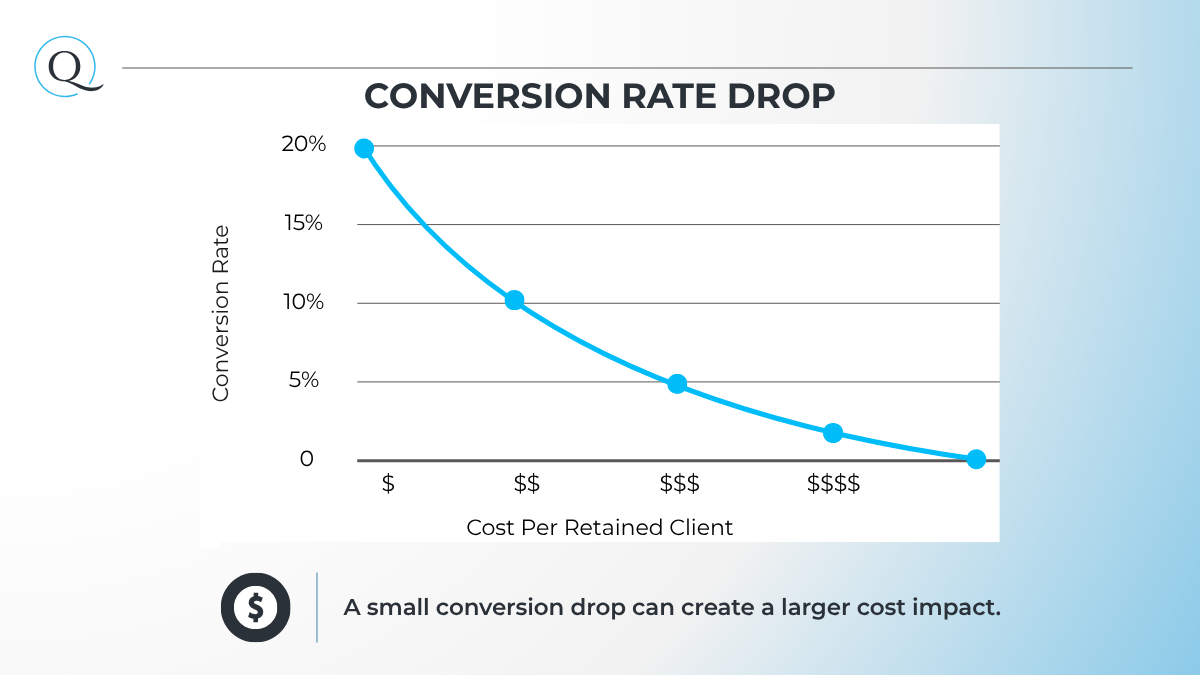
The first test is simple: ask what happens if conversion drops by 10% to 20%.
This does not require complex financial modeling. The point is to see how much room each source has before the economics become uncomfortable.
For example, imagine a source produces 100 leads in a month. If 10 of those leads become signed retainers, the lead-to-retainer conversion rate is 10%. If that conversion rate drops to 8%, the same 100 leads now produce eight signed retainers. That may sound like a small change, but it means the firm needs either higher volume, better conversion, or lower acquisition cost to return to the original result.
Now look at the source cost. If the firm paid $10,000 for those 100 leads, the apparent cost per lead is $100. At 10 signed retainers, the cost per retained client is $1,000. At eight signed retainers, that number rises to $1,250.
The stress test is clear: the source did not become more expensive at the lead level, but it became less efficient at the signed-retainer level. That is why cost per lead can be misleading when reviewed by itself. A source that looks inexpensive at the top of the funnel can become costly when conversion slips.
Stress Test #2: Measure Lead Quality by Signed Outcomes
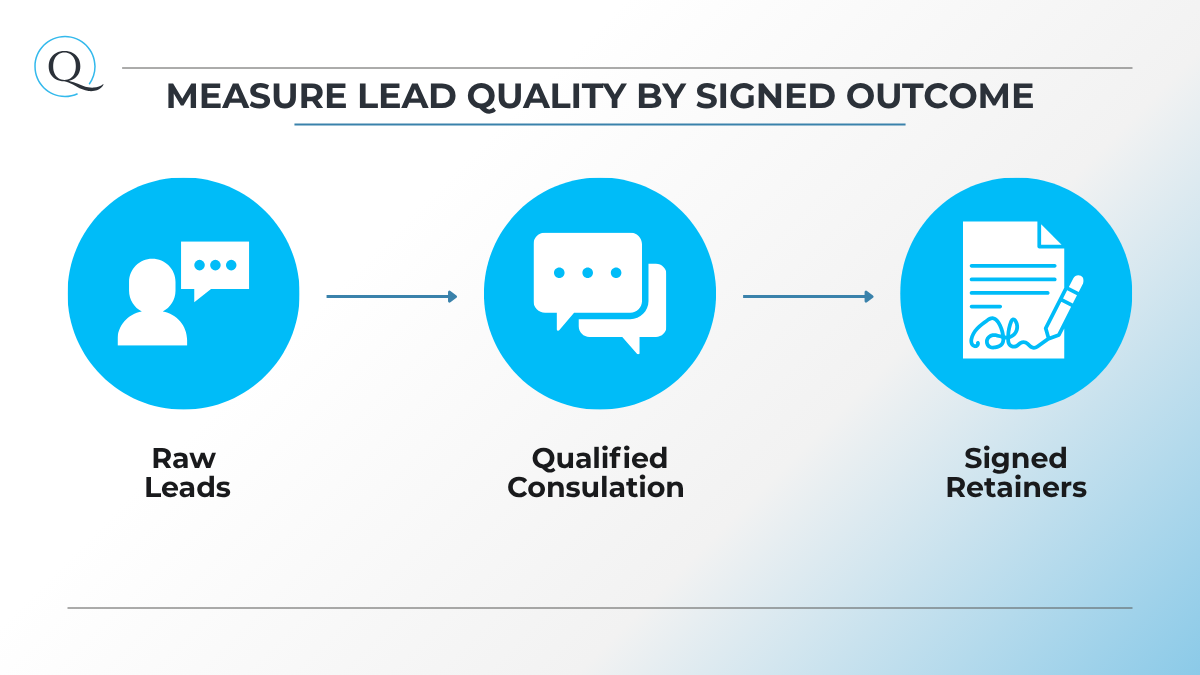
Lead quality should be measured as close to the signed retainer as possible.
Raw lead count can show demand, but it does not show whether the demand is usable. A stronger review looks at qualified consultations, signed retainers, disqualification reasons, duplicate rates, credit or replacement requests, and cost per retained client.
This requires disciplined intake data. The firm needs to know why leads are being disqualified, whether the same issues repeat by source, and where viable opportunities are falling out of the process. “Bad fit” is not enough detail. A useful CRM should be able to show whether a lead was outside the practice area, outside the geography, already represented, difficult to reach, missing essential information, or otherwise unlikely to move forward.
Reporting integrity matters because source decisions are only as strong as the data behind them. If disqualification reasons are vague, follow-up outcomes are inconsistent, or signed retainers are not tied back to the original source, leadership may be comparing incomplete stories instead of actual performance.
Without that level of source-level reporting, it becomes hard to tell whether the firm has a marketing problem, an intake problem, a tracking problem, or some combination of all three.
Stress Test #3: Pressure-Test Intake Capacity
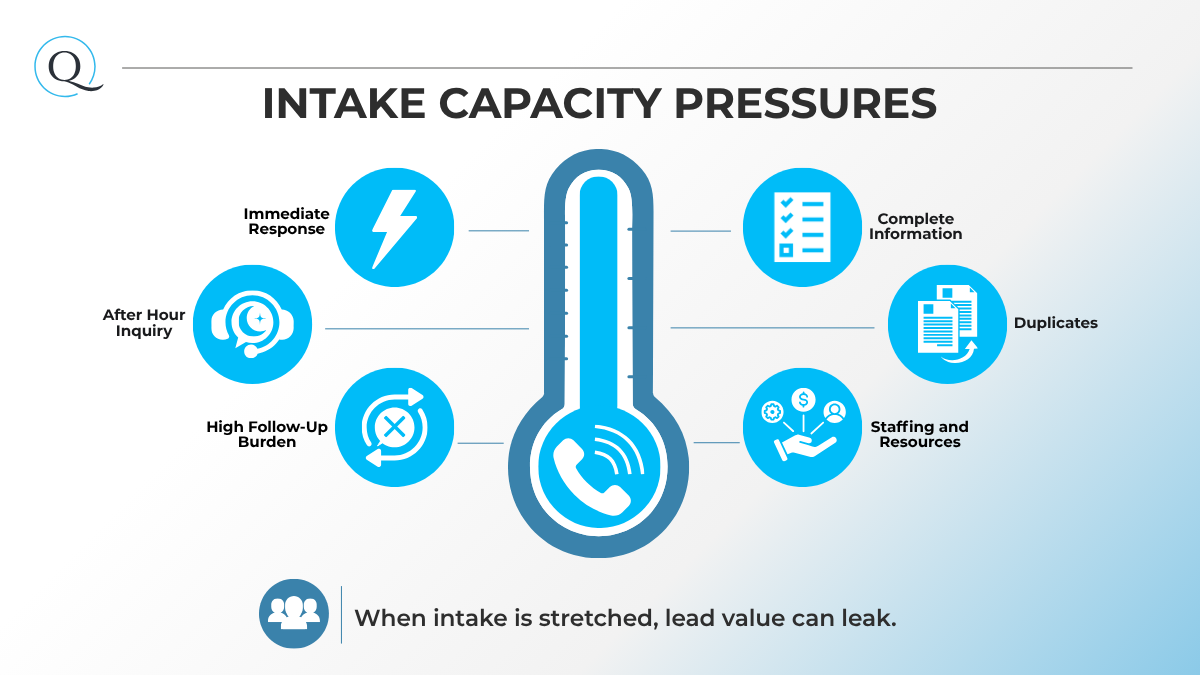
This test asks how much operational drag each source creates. Does the lead arrive with complete information? Does it require immediate contact to remain viable? Does it produce a high follow-up burden? Are there duplicates? Do after-hours inquiries receive fast enough attention? Does the intake team have the staff, scripts, routing, and tracking needed to handle the source well?
Responsiveness matters. In its 2024 Legal Trends Report, Clio reported that only 40% of firms answered the phone during its secret shopping study, down from 56% in 2019. For PI firms, that gap can become expensive quickly. When a lead source depends on fast response, but intake is already stretched, potential value leaks before the firm can evaluate the opportunity.
This is also where source quality and intake efficiency meet. Better-qualified inquiries can help intake teams focus their time where it has the best chance of producing a retained client. Lower-fit volume can create motion without momentum.
Stress Test #4: Compare Source Resilience, Not Source Cost
A resilient source should be evaluated by how it behaves under pressure. What happens if market costs rise? What happens if volume dips? What happens when a key intake employee is out, competition increases, or follow-up takes longer than usual? Which sources still produce qualified consultations and signed retainers? Which ones become noisy, expensive, or difficult to manage?
This comparison helps PI firms avoid overvaluing sources that only work in ideal conditions. A lower-cost source may be worth keeping if the signed-case economics are strong and intake can manage it efficiently. A higher-cost source may be worthwhile if it produces better-fit inquiries, fewer disqualifications, and more predictable signed outcomes.
The question is not which source is cheapest. The question is which source gives the firm the clearest path from inquiry to signed retainer.
How Quality Buffers Volatility
No lead source removes volatility. Markets shift, competitors adjust, costs change, and client behavior is never perfectly predictable.
Quality gives the firm more room to operate. Better-qualified leads reduce sorting time, cleaner reporting shows which sources are producing retained clients, and stronger intake control helps leadership make decisions from signed outcomes instead of surface activity.
That does not make the pipeline immune to pressure. It makes pressure easier to see, measure, and manage before the firm spends more to solve the wrong problem.
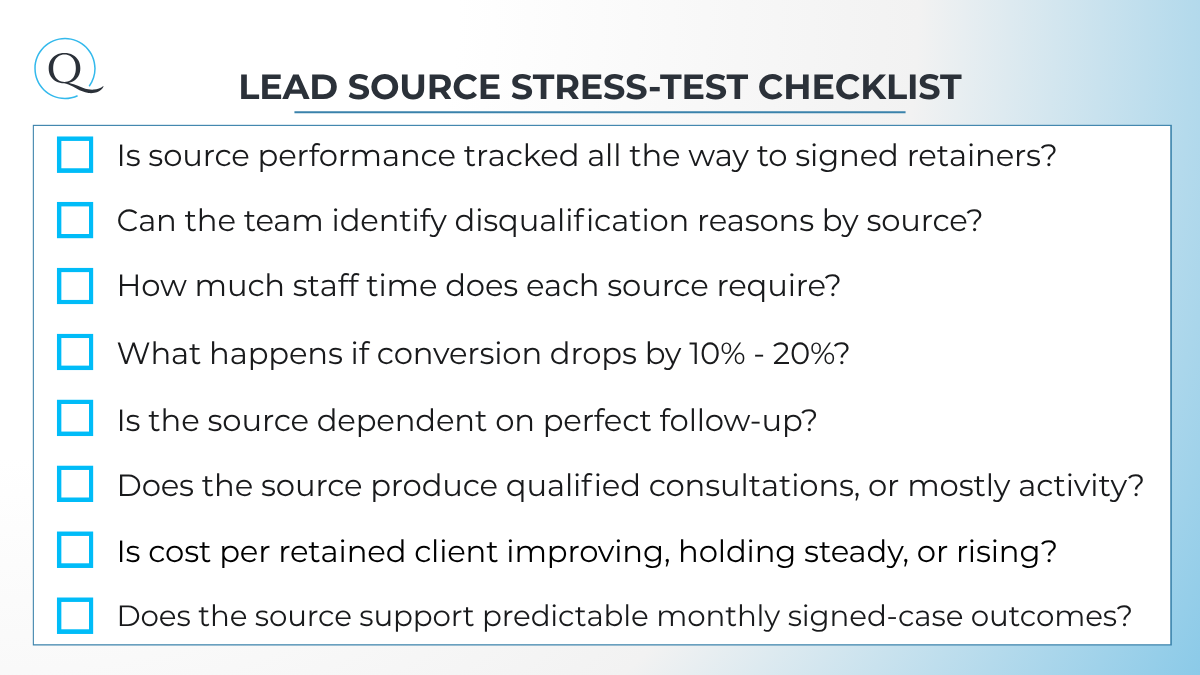
A Simple Lead Source Stress-Test Checklist
Use these questions to review personal injury lead sources more rigorously:
- Is source performance tracked all the way to signed retainers?
- Can the team identify disqualification reasons by source?
- How much staff time does each source require?
- What happens if conversion drops by 10% to 20%?
- Is the source dependent on perfect follow-up?
- Does the source produce qualified consultations, or mostly activity?
- Is cost per retained client improving, holding steady, or rising?
- Does the source support predictable monthly signed-case outcomes?
Build for the Conditions You Actually Face
A lead pipeline that only works when volume is high, intake is fully staffed, follow-up is fast, and conversion rates hold steady is vulnerable. The stronger test is whether a source can continue producing qualified opportunities when normal pressure enters the system.
For PI firms, that means looking beyond cost per lead and asking better questions about resilience, quality, intake workload, and signed outcomes. Lead volume still matters, but it should not be the number that carries the whole decision.
Quintessa helps personal injury firms move from lead volume to qualified, retainer-ready demand by managing inbound opportunities from first inquiry through signed retainer.
Request an intake overview to better understand how your lead sources are performing from first inquiry to signed retainer.